
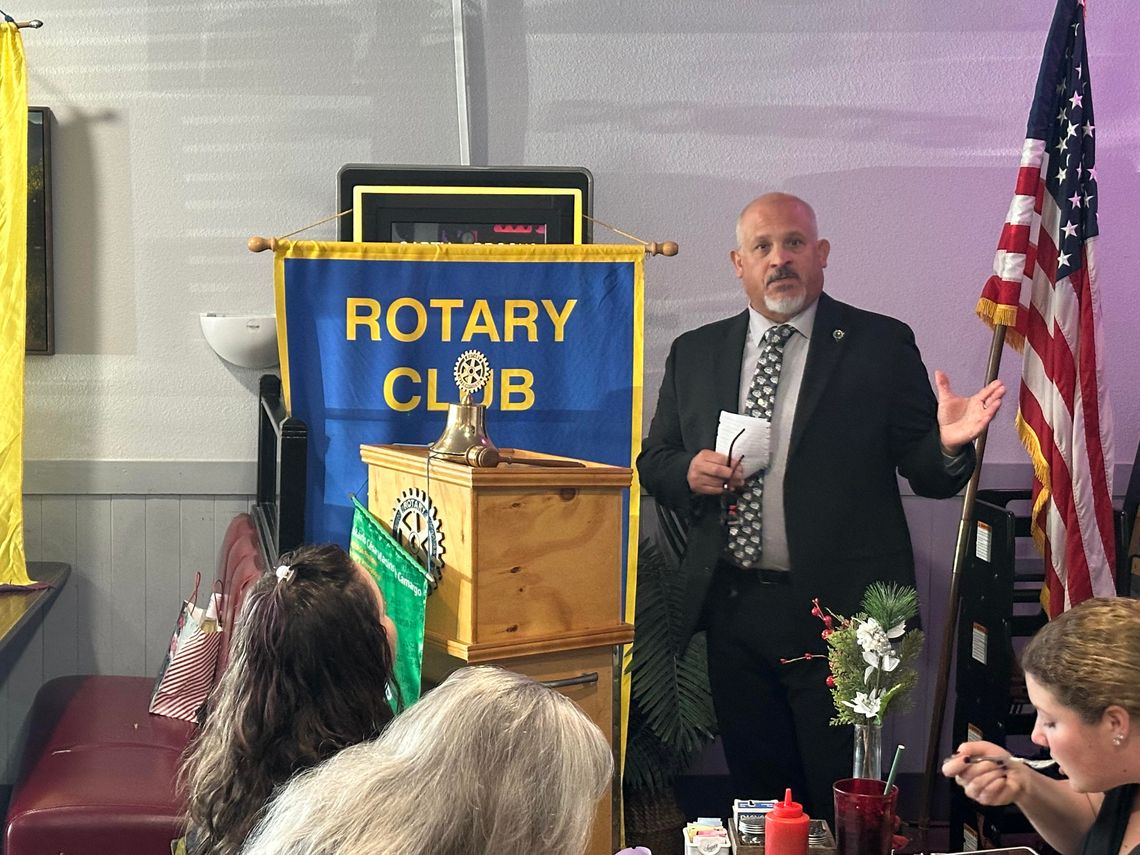
Fernley City Councilman Albert Torres gave the Rotary Club of Fernley a brief overview of some of the council’s work over the past year and some of the major issues ahead at the club’s Jan. 5 meeting.
Torres was appointed to the council in August 2019 following the resignation of Sue Seidl, who moved out of the area. He won election to the seat in 2020 and was reelected in 2024.
Water and sewer facility upgrades were among the topics Torres highlighted. In August, the council voted to move forward with planning for water and sewer treatment improvements. The city’s current sewer treatment facility is not capable of reducing nitrogen, a consultant told the council. The city wants to upgrade the quality of the effluent leaving the sewer treatment plant to be able to sell it to industrial users or for irrigation. Torres said the proposed site is an 80-acre parcel directly north of the existing facility, which is east of the industrial park along Newlands Drive.
Torres said the goal is to complete the project by 2030, calling that timeline realistic. The estimated cost is $50–55 million, most of which the city expects to cover through grants.
“This is the only project, and I’m speaking only for myself as far as council here, the only project where I would say yes to bonding, because it’s that important,” Torres said.
Regarding water, three of Fernley’s monitoring wells have PFAS, or polyfluoroalkyl substances, levels slightly above the 4 parts per trillion recommended by the Environmental Protection Agency.
Torres said PFAS contamination is a nationwide issue.
“Almost every single entity across the country has PFAS in their water,” he said, noting it is often a byproduct of piping and lining materials used in water treatment and distribution.
He said Fernley’s water remains among the cleanest in Nevada. The city is adding filtration systems and replacing aging components, largely funded through the water and sewer enterprise fund. He said the city is working with the U.S. Economic Development Administration on grant funding for upgrades to the water treatment plant.
Torres discussed the city’s first Special Assessment District, created last year for Nevada Pacific Parkway, and the ongoing study of potential impact fees.
Developers, he said, have increasingly asked why Fernley lacked SADs or impact fees, prompting the city to begin evaluating both tools.
Once the extension of Nevada Pacific Parkway is completed, Torres said NDOT will assume responsibility for the parkway because the city lacks the expertise and equipment to maintain bridges. In exchange, Fernley will take over Farm District Road. Torres said he hopes improvements to Farm District Road, including the extended bike path and crosswalks with flashing lights, will be completed.
Torres said the city is working to repair its relationship with NDOT, which he said was damaged when previous city administration threatened a building moratorium over the inadequacy of the roundabout. Last January, the council approved a resolution that exempts the roundabout from the minimum Level of Service the city requires, allowing development to continue.
“Council is not going to approve a building moratorium,” he said, while acknowledging the roundabout was undersized from the beginning.
“Anybody who was here at the time knew that it was too narrow,” he said.
Torres said he hopes completion of Nevada Pacific Parkway will divert a significant share of traffic away from the roundabout.
Torres noted that the Lyon County Regional Transportation Commission recently approved funding for planning and design work on Miller Lane, Sixth and Seventh streets, and the alphabet streets. He also highlighted the completion of the Community Response and Resource Center and the lease the council agreed to with the Boys & Girls Club to operate the facility. Torres praised the Boys & Girls Club’s progress in finding private funding for the Early Learning Center, which is Phase II of the CRRC.
Torres closed with a reflection on the state legislative climate. He lamented that Assembly Joint Resolution 1, which would have been a step toward resetting property taxes when property is sold, was killed by the Senate. He said much legislation was defeated by elected officials playing politics instead of making policy.
“A lot of great bills introduced by R’s were shut down by D’s, and a lot of great bills introduced by D’s were shut down by R’s,” he said. “And we’ve got to get away from that.”


Comment
Comments