
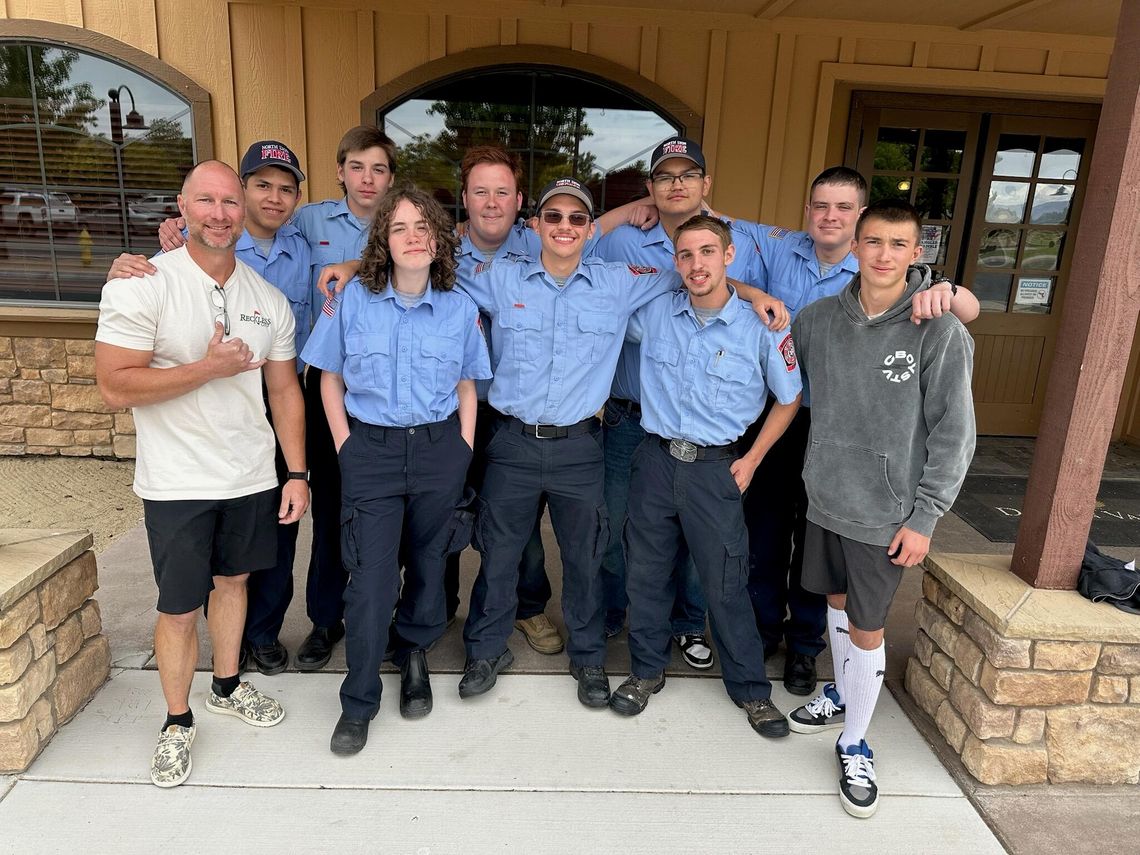
North Lyon firefighter Jesse Richardson fought back tears the night of April 3 when he presented one of the department’s fire cadets with the Chief Carr Award, an honor named for one of the mentors who shaped his own early years in Nevada.
Richardson, who served as a firefighter at North Lyon Fire for 13 years until leaving the department for a job with Storey County Fire earlier this month, created the cadet program in 2019 with three cadets. The program now has 12, a number he settled on as the ideal size because of what he called the fire service span of control.
“In the fire service, span of control is anywhere from five to seven being optimal,” Richardson said. “With my two lieutenants I can split that 12 into six, which is right in the middle of the five to seven. I can tell my lieutenant what I want and then they can delegate their responsibilities down to them.”
Richardson said he created the cadet program not as a recruiting tool, but as a way to give teenagers the kind of mentorship he believes too many go without. After more than two decades in the fire service, he wanted to give back in a way that reached beyond emergency calls. He said the program was his way of meeting kids where they are, offering structure, skills and a sense of belonging.
“It’s just to be a mentor to these young kids and give them a foundation and ethics and morals of being a just all-around good person,” Richardson said. “You don’t have to be interested in firefighting. If you want to be part of a group and have camaraderie and friendships and hang out, that’s pretty much what this program is.”
For many cadets, that mentorship has already made a difference. Marcus Landa was in ROTC as a freshman at Reno High and joined the cadet program after moving to Fernley. Now a senior, his goal is to become a mechanic in the Army, then either go into a career in firefighting or mechanics.
“This has helped me become self-responsible, disciplined and not give up easy,” Landa said.
The cadet program is open to students ages 14 to 18 as long as they are in high school. Once they join, cadets move through a wide range of training. They get exposure to fire, EMS, rope rescue, HAZMAT and wildland operations, along with practical household skills like plumbing basics, electrical troubleshooting, changing oil and tires, and even how to handle a job interview. Their certifications limit what they can do on emergency scenes, but they support the department through community service, such as helping with the Northern Nevada Children’s Cancer Foundation fundraiser or doing yard work for seniors. At structure fires, they assist the Rehab Team, helping crews get equipment back in service.
For Jasmine Hidalgo-Gates, a junior at Silver Stage High School, the program opened doors she didn’t know existed. Hidalgo-Gates is interested in working in the fire service and she found out about the program while searching online for programs that could help her prepare for that. Now she commutes to Fernley for meetings and cadet activities.
“That’s how good this program is,” she said. “I think this program has definitely taught me a lot about what being a firefighter is and definitely helped me improve physical training.”
Hidalgo-Gates said she realized she didn’t have the physical strength to be a firefighter and is now considering the Air Force after high school, but said the program has given her valuable skills and confidence.
Each cadet is assigned a task book which has four phases. Cadets earn red, white and blue pins for completing the first three phases, and a red, white and blue pin for completing the fourth. Completing the phases is optional, depending on how much time each cadet can dedicate, and so far none have completed all four.
Among the 12 cadets are two lieutenants, Travis Dodge and Otto Lynch, who earned their positions through a testing and interview process.
“And then also on how they act around the cadets,” Richardson said. “If I see someone that is really trying to take someone under their wing and show them how to do things, that is a consideration on top of how they answer the questions.”
Previous cadets who graduated have gone on to wildland firefighting, engineering, physical therapy, nursing, sports therapy and diesel mechanics.
Lynch, a senior at Fernley High School, was promoted to cadet lieutenant in September 2023 and is one of the cadets interested in remaining in fire service. His father is a Lyon County Sheriff’s deputy, but said his dad has tried to steer him away from a law enforcement career. Instead, he hopes to become a fire marshal.
“It’s definitely matured me a lot more, being in charge of people,” Lynch said. “I’m still a little immature, but that comes with being a teenager. It’s forced me to be there to help people, when they need help.”
Cadets meet weekly for three hours. The last hour is dedicated to physical training, where they learn proper weightlifting and cardio techniques. They are also allowed to do 8-hour ride-alongs any day of the week, mostly observing during incidents, but they can participate in training alongside firefighters.
“Each one of them are given turnouts so they can do hands-on training, auto extrication and firefighter drills,” Richardson said.
Gunnar Beemer, the cadet who received the Chief Carr Award, is also enrolled in the EMT class at Fernley High School and hopes to become a critical flight paramedic.
“I took the chance to get First Aid certified and I realized that I’m good at applying the skills that I’m taught in a real-world setting,” he said. “This definitely gave me a head start.”
The cadets can also earn scholarships through the program. In 2024, Richardson said four cadets graduated and he presented them with a total of almost $10,000 in scholarships. Money for the scholarships comes from fundraisers the cadets do, like their annual golf tournament and car washes.
“So they’re kind of working to earn their own scholarship money, in a way,” Richardson said.
With Richardson’s departure, the program is now being run by North Lyon Support Staff Captain Daniel Hiles, who has served the district for six and a half years as a volunteer firefighter. Hiles said he intends to blend the cadet program with the volunteers to expand mentorship opportunities.
“The cadet program is kind of like an introduction to volunteers,” Hiles said. “It’s a good segue going into that program.”
For some, the program’s impact is as simple as seeing someone they admire. Omar Adame said he became curious after seeing Lynch wearing his cadet uniform at school. Now he’s considering either becoming a firefighter or going into plumbing while doing volunteer firefighting.
“I think Jesse has been a great role model,” Adame said.
While breaking the news of his new job to the cadets, Richardson promised them he would remain in contact with them and with Hiles, a reminder that the legacy behind the Chief Carr Award isn’t leaving the district, or them, behind.


Comment
Comments