

Caption: Debbie Skinner, Alisa Rhyno, and Tim Bickerton take the oath of office. Courtesy City of Fernley.
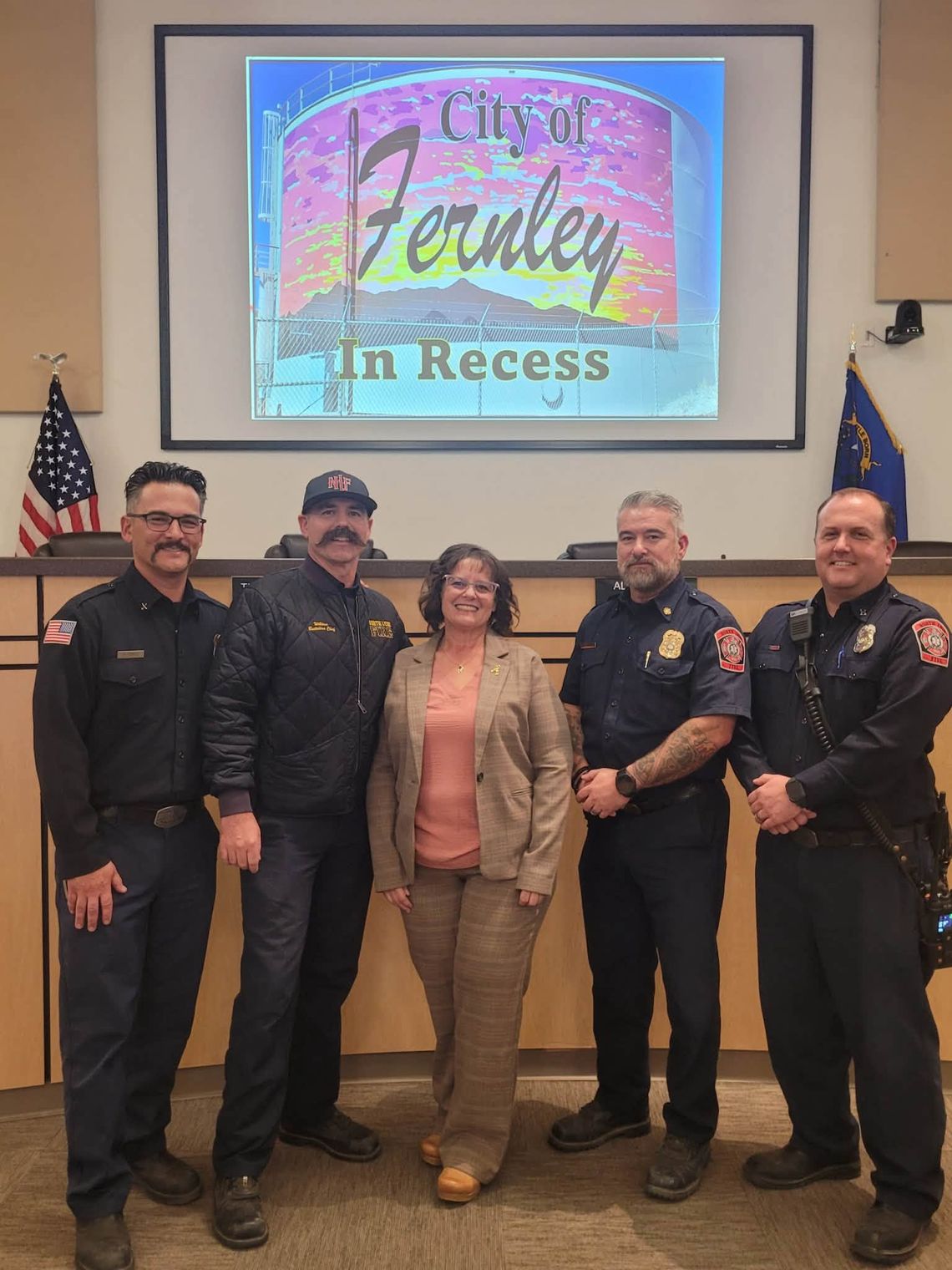
Members of the North Lyon Fire Department with newly elected councilwoman Debbie Skinner, who also serves as the Board of Fire Director. Courtesy NLFD.
By Rachel Dahl
A new mayor and two new councilwomen took their oaths of office Nov. 18, beginning a new chapter in Fernley city government as the council moved through an agenda that included development projects, infrastructure spending, and a proposed new framework for commercial and residential growth.
Mayor Tim Bickerton and Councilwomen Debbie Skinner and Alisa Rhyno were sworn in together during the opening portion of the meeting. Bickerton replaces Neil McIntyre, while Skinner and Rhyno take the seats previously held by Ryan Hanan and Stan Lau.
The new council includes three women, with Skinner representing Ward 1, Felicity Zoberski in Ward 2 and Rhyno in Ward 3. Lyon County Sheriff Brad Pope noted during his report that it appeared to be the first female majority in Fernley City Council history.
Councilman Joe Mendoza offered his own observation while welcoming the newly elected members.
“Hopefully we could turn this to a boy girl competition since there's three of you here now,” Mendoza said.
Bickerton thanked voters for their participation and asked residents to hold the new council accountable.
“I ask you all to keep us informed of your concerns. Point out if we make a mistake in your opinion and keep us in line,” he said. “We work for you. We know we do.”
The council then continued with a series of decisions affecting Fernley's development and municipal operations.
One of the first discussions involved a $46,500 engineering contract with Shaw Engineering to design an emergency backup generator for City Hall.
Bickerton questioned the design expense compared with other city projects. City Engineer Salvador Plaza explained that the proposed generator would require new electrical connections, unlike a generator planned for the community recreation center, where infrastructure was included during construction.
Staff estimated the City Hall generator project itself would cost approximately $700,000.
Mendoza questioned whether waiting for additional qualified engineers might produce a more competitive price. Staff said a new consultant list was being developed but likely would not be available until January.
The council ultimately approved the engineering contract 4-1.
The council unanimously approved a development agreement extending the deadline for the 37-lot Wilson Landing subdivision to Dec. 31, 2028.
The project, located near Ricci Lane and Wilson Way, was originally approved in 2020 but experienced delays before changing ownership.
The council also approved the removal of two existing access easements to allow the development to proceed. During public comment, resident Tammy Dipman questioned whether emergency evacuation routes would be adequate. Staff identified an existing emergency access, while Chief Development Officer Michelle Rambo offered to discuss the concerns further.
The council also held the first reading of the proposed Vaquero Outpost planned development ordinance, which would establish new zoning and development standards for property along U.S. Highway 95A.
Councilwoman Zoberski raised concerns about traffic, building heights, landscaping responsibilities and whether the development could eventually include data centers before the city adopts its proposed data center regulations.
“I don't want to approve a handbook that allows for data centers as permitted uses for that zoning area,” Zoberski said, questioning how future regulations would apply.
Planning Director Treston Rodriguez explained that the Planning Commission had recommended additional conditions addressing data centers, pedestrian safety, and fire protection.
The proposal will return to the council Dec. 2 for a second reading and possible action.
The city is also scheduled to hold a public workshop on proposed data center regulations Dec. 10 from 3 to 7 p.m. in council chambers.
The council voted 5-0 to authorize applications for two Community Development Block Grant projects.
The first seeks $30,000 toward a $40,000 preliminary engineering study for parking and sidewalks at In-Town Park. The second requests $93,750 toward a $125,000 community needs assessment and strategic plan. Both would require local matching funds if awarded.
Council members also approved a $103,664 contract to conduct fire-flow testing on approximately 1,178 city-owned hydrants.
During a facilities assessment presentation, architects reported that City Hall is crowded and may eventually need to be relocated. The Cottonwood maintenance yard was also described as too small for the city's needs.
Additional cost estimates and recommendations are expected in future reports.
The council's next regular meeting is scheduled for Dec. 2 at 5 p.m.






Comment
Comments