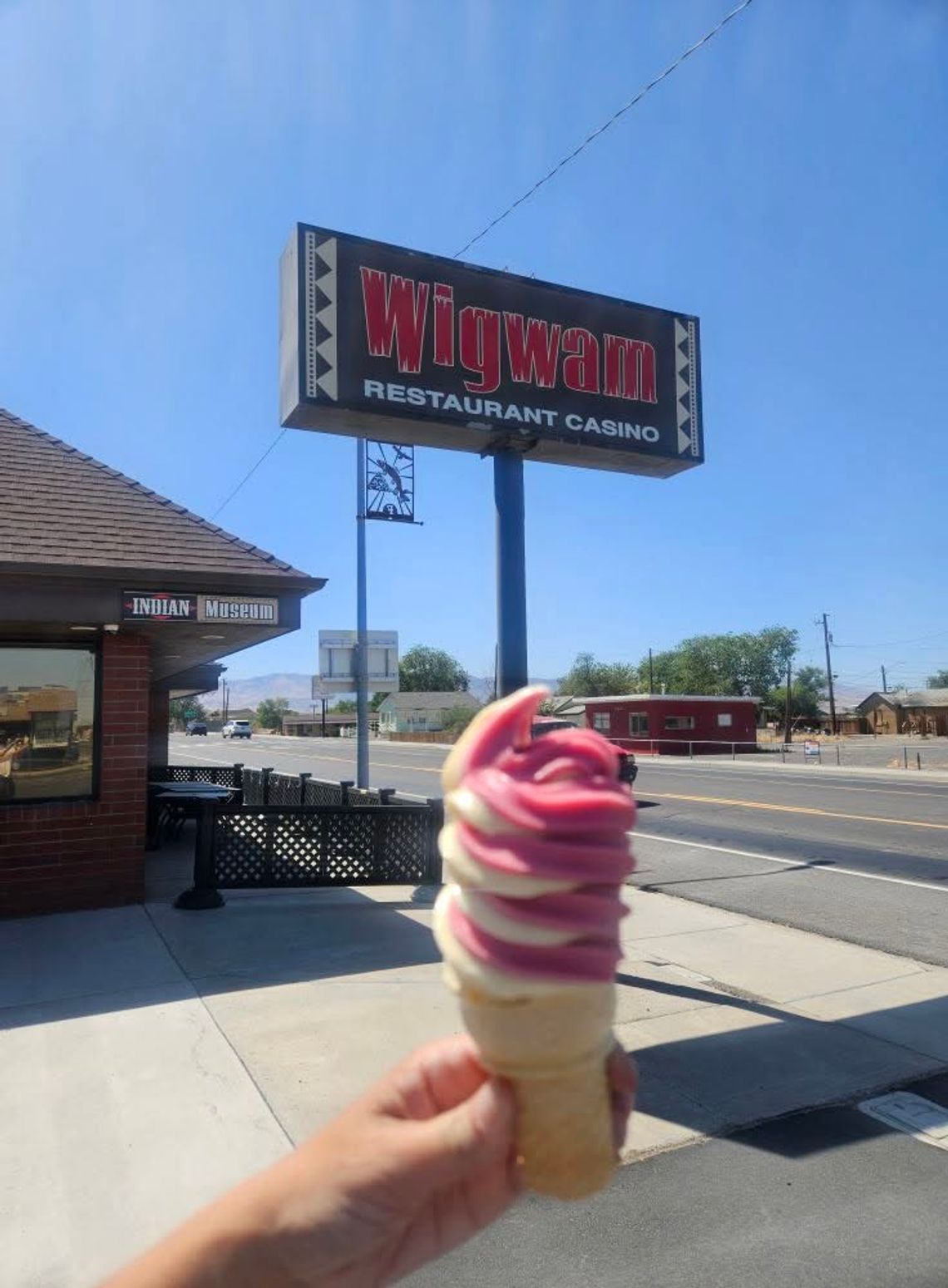
Before it was the Wigwam, it was the Dainty Cone.
According to local history, Mary Aratibel opened the Dainty Cone in April 1961. Hamburgers were 35 cents, and coffee and ice cream cones were a dime.
And before Mary Lou Prather Aratibel Royels became a familiar name in Fernley, she was a Tennessee teenager heading west for a job.
Born back East, Mary grew up in a large family. Her father was a coal miner, and money was tight. But her mother made sure all her children learned to read.
Mary took a train west to find “a better life” and got a job as a telephone operator for the Bell System in Sacramento. She sat on a stool with wheels in front of a large switchboard, connecting calls with wires like Lily Tomlin’s Ernestine on Laugh-In.
When Mary and a friend heard they could earn more in Reno, they moved there. Somewhere along the way, she met and married, then divorced, Gene Aratibel. Dick Jackson, who grew up in Fernley, knew Mary well.
Dick doesn’t know why she moved to Fernley from Reno, or when she and Gene divorced. Mary and Moe, aka Morris Royels, married in 1964.
Dick says his memory isn’t perfect, but this is what he does remember. Jackson recalls that Moe, who grew up here, had trained in an Army culinary school to prepare meals for officers and was a fantastic chef.
Dick felt Mary brought the drive and business sense to their businesses. Moe brought his cooking skills and personality, including dinners that drew people from other towns.
But back to the Dainty Cone. Originally, there was no indoor seating. Picnic tables and awnings in the back gave customers a place to eat. Well-known Fernley builder Ronny Gott later began expanding the drive-in restaurant to the south for them.
First, though, they had to weather a major change in 1964.
Fernley's Main Street carried U.S. Highway 40, which in the West followed much of the historic Lincoln Highway route from Times Square to San Francisco. Travelers drove through town, helping support its small businesses. When Interstate 80 bypassed downtown Fernley in 1964, much of that traffic disappeared. Restaurant revenue crashed from $52 a day to $15 a day. Moe said in a Yerington Monday newspaper interview that they took jobs cleaning houses on the side.
Despite, or because of, that huge loss, they were intent on building an addition for indoor dining. They were trading, as they said, hamburgers for dirt. “We traded anything we had to get the room built,” Mary said in an early Yerington news article.
The Royels kept working. In spring 1984, the Dainty Cone became a full-service restaurant called Mary and Moe’s Wigwam. Dick’s impression was of them as great hosts.
“For you, you thought you were just going there to get a meal. For them, when you were eating there, it was like you were at their house as a guest. This was their personal dining room, and you were welcomed there. Moe would come and sit at your table and ask if you needed more bread. You just knew that he would come over. This was their life. At 4 a.m. they came in and started the coffee. They knew everybody. And everybody from cowboys to congressmen ate there.”
Jackson remembers homemade chili, liver-and-onions dinners and prime rib nights.
“People were coming from Fallon and Yerington and Reno out here to dinner,” he said.
Once, when the restaurant ran out of chili, Jackson teased a waitress.
“How hard is it to open a can of Dennison’s?”
She quickly and indignantly defended the chili as being homemade. He had to explain that he was kidding.
The crowds were no joke.
“On a weeknight, if you got there after six o’clock, you probably had to wait 20 to 30 minutes for a table,” Jackson said.
He remembers four dining bays filled with tables and booths, including space on the east side that now holds slot machines. He also knew the couple through his insurance work, insuring their Five Springs Ranch near Gerlach and a house on Country Drive. He says he told them to buy the ranch to get away and relax. They retired there in 2005.
Mary also worked in real estate. She bought the former Aldrich Hotel across from the fire department, renamed it the Prather Building and opened her office there. The building’s earlier life had included a stint as a bordello, with women upstairs and a bar downstairs, long before her real estate business.
Then there were the Indian artifacts.
At the Wigwam, food was only part of the attraction. Mary and Moe had a huge collection of Native American artifacts from northwestern Nevada. The museum included some artifacts dated to 10,000 years old.
Glass cases throughout the seating area held baskets, beadwork, arrowheads and other objects customers could admire while waiting for their meals. Western art and old photographs covered the walls.
A 2004 Nevada Magazine article described the collection, much of it from the Pyramid Lake Paiute Tribe. According to a 2019 auction catalog, local Paiute friends made some clothing especially for Mary and Moe. Many Paiute elders donated to their collection, considering it a museum heritage collection, but after Mary and Moe’s deaths, the collection was sold.
In March 2019, Holabird Western Americana Collections offered the Wigwam Collection at auction. Items included woven baskets, cradleboards, moccasins, beaded clothing and artwork.
One familiar piece was a six-foot-tall, hand-painted wooden figure of a Native American chief, signed by carver John Gallagher. Its auction estimate was $1,200 to $2,000.
Leah Wilkinson of Yerington, who publishes the Pizen Switch, bought it for $900.
“I just could not bear to see it leave the area,” she said.
Today, Victor and Cassie Serna are part of the Wigwam’s next chapter. As owners of the restaurant business, their menu still includes diner favorites like the Big Moe and Lil’ Moe cheeseburgers.
The restaurant still helps bring neighbors together. In 2025, Wigwam staff joined the Rotary Club of Fernley, community volunteers and Fernley High School leadership students for the Rotary Club’s free annual Community Thanksgiving Dinner. More than 300 meals were served there, and about 100 more went to homebound residents, according to The Fernley Reporter.
“We love doing these kinds of events and bringing happiness to the community,” Victor told the newspaper.
From picnic tables behind a little drive-in to community dinners, the Wigwam has given generations of Fernley residents a place to gather.



Comment
Comments