
Go to main contentsGo to main menu
Friday, November 13, 2026 at 4:17 PM

Comstock celebrates solar-panel recycling plant in Silver Springs

Facility designed to process 3.3 million panels annually
Comstock celebrates solar-panel recycling plant in Silver Springs
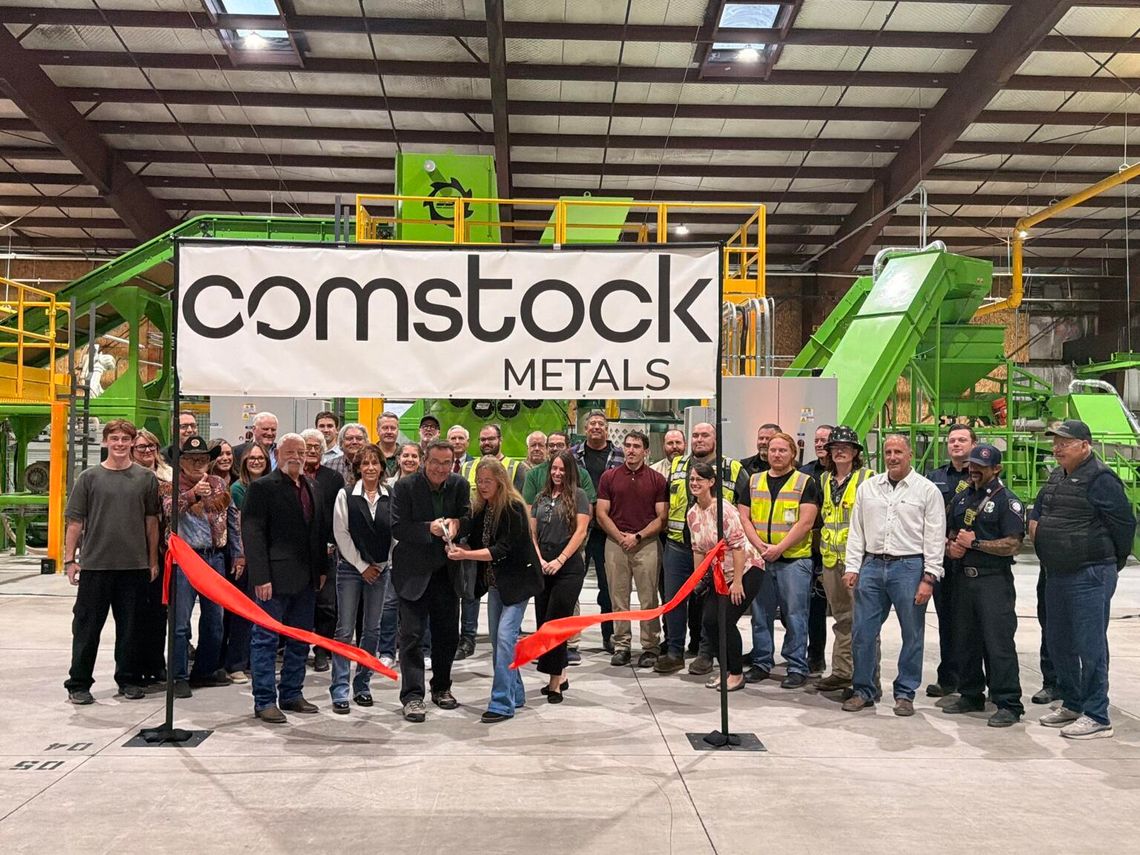
Scott Keller, Commissioner Tammy Hendrix, Corrado De Gasperis, and Vida Keller along with Comstock employees, Lyon County employees, and supporters last week at the grand opening of Comstock Metals recycling operation in Silver Springs. Photo by Rachel Dahl

Comstock Metals celebrated its solar-panel recycling facility in Silver Springs on Oct. 16, marking the culmination of what company CEO Corrado De Gasperis described as a four-and-a-half-year journey from laboratory testing to industrial production.

The ribbon cutting brought together local officials, community members and company employees at the Lake Avenue facility, where a production line is designed to process approximately 3.3 million retired solar panels annually.

The celebration followed the company’s September announcement that the plant had begun operating continuously. Comstock said its next priority was increasing the volume of panels processed. The annual capacity figure represents the system’s design capability, not a reported production total.

For De Gasperis, the project represents both a business opportunity and a way to address what happens to solar panels after they stop producing electricity.

Speaking before the ribbon cutting, he said the company expects growing quantities of panels to require recycling as older installations are retired or replaced.

The Silver Springs operation is intended to recover usable materials rather than send discarded panels to landfills.

From mining to recycling

De Gasperis traced the company’s investment in Silver Springs to its roots in the historic Comstock mining district.

He recalled initially knowing little about Silver Springs before local advocates encouraged him to consider investing there. As he learned more about its industrial land, transportation opportunities and community plans, the company began acquiring property.

The recycling business emerged through another change in direction.

Comstock had explored lithium-ion battery recycling, De Gasperis said, but encountered difficulties separating valuable materials from plastics, adhesives and other contaminants.

That work brought him into contact with Fortunato Villamagna, now president of Comstock Metals. De Gasperis said Villamagna encouraged the company to consider solar panels instead.

The appeal was twofold: customers would pay to have retired panels processed, while the materials recovered could have value of their own.

De Gasperis said the team spent months evaluating the opportunity before committing to the new direction.

Recovering materials

At the ceremony, De Gasperis said the company had invested approximately $15 million in the production line. He described equipment capable of accepting a panel roughly every seven seconds.

The process separates aluminum, glass and a finer material containing silver and other metals, he said.

Comstock describes its operation as a zero-landfill recycling process. The company is also developing additional technology to extract metals from the material remaining after initial processing.

In an August update, Comstock distinguished between bringing its recycling system online and developing its downstream metals-recovery process, which included plans for a separate pilot system.

De Gasperis said he sees the potential for a network of recycling facilities to become a significant domestic source of recovered silver. That remains a company ambition rather than an established production result.

Building an operation in Silver Springs

De Gasperis described the work of converting the building, designing the equipment and obtaining state and county approvals as a lengthy process.

He credited Lyon County commissioners, planning commissioners, local business advocates and emergency-response agencies with asking questions and working through an unfamiliar industrial proposal.

The company also acquired nearby property to accommodate panel storage and future needs, he said.

Throughout his remarks, De Gasperis returned to the importance of local support and creating opportunities for residents to work close to home.

He said the region’s growth should give young people a reason to return after school and build careers in their own community.

The project has also received state economic-development support. In February, Comstock announced approximately $900,000 in Nevada tax abatements tied to plans for at least 43 jobs and more than $12 million in capital investment during the first year of operation. Those figures were commitments associated with the abatement program, not a current employment count.

For the employees and supporters gathered Oct. 16, the ribbon cutting marked a visible milestone: equipment developed through years of testing was now operating inside a Silver Springs industrial building.


Share
Rate

Comment

Comments

COMMENTS
Comment author: John Mueller Comment text: FERNLEY’S WATER EMERGENCY: FIVE QUESTIONS STILL NEED ANSWERS The November 12 Fernley Reporter article provides a good recap of the November 3 water emergency and the November 4 City Council meeting. First, credit where credit is due. Our city employees responded, restored operations, and took precautions to protect residents. That’s important and appreciated. But fixing the immediate problem isn’t the same as preventing it from happening again. There are five reasonable questions our community deserves answers to: 1. WHAT ACTUALLY FAILED? What was the root cause of the water treatment plant’s communication failure, and why didn’t the backup systems prevent the interruption? 2. HOW CLOSE WERE WE TO A REAL EMERGENCY? How much usable water remained in storage, and how close did we come to affecting essential services, including firefighting? 3. WHAT WILL THIS COST TAXPAYERS AND RATEPAYERS? What did the emergency cost, what additional repairs or upgrades are necessary, and how will they be funded? 4. WHO IS RESPONSIBLE FOR MAKING SURE IT DOESN’T HAPPEN AGAIN? Is there a written corrective-action plan with assigned responsibilities, measurable results, and completion deadlines? 5. HOW WILL RESIDENTS KNOW THE PROBLEM IS REALLY FIXED? Will the city publish an after-action report explaining what happened, what was learned, what has been corrected, and what still needs attention? This isn’t about pointing fingers or finding someone to blame. It’s about learning, improving, and protecting our community. We can appreciate the city’s response while still expecting transparency, accountability, and a commitment to continuous improvement. Some technical information may need to remain confidential for security reasons. But that shouldn’t prevent residents from understanding the risks, the corrective actions, and the results. The real question isn’t whether Fernley recovered from the November 3 emergency. We know it did. The question is: If the same failure happened tomorrow, would we be better prepared? That’s a conversation worth having. Our community deserves more than reassurance. It deserves measurable results. Comment publication date: 11/12/26, 1:54 PM Comment source: Fernley Council Addresses Water Emergency Comment author: Donald DeVold Comment text: Great article It’s actually spelled DeVold Thank you Comment publication date: 10/29/26, 4:58 PM Comment source: The great robbery: Strip-6 by Solis helps Vaqueros punch playoff ticket Comment author: CH Comment text: I want to start a betting 'pool' for the October, November, and December closures: 1. A dent in the pool slide. 2. A failed breaker. 3. A pebble loose in the water part (replacing all concrete) 4. Hurricane Polo makes a sudden turn and blows off the roof (again). With soft muscles after 7 months of no swimming, the only health left is my sense of humor :) Comment publication date: 10/1/26, 11:18 AM Comment source: Fernley Pool Renovation Moves Forward, One Test at a Time Comment author: PFB Comment text: Why can't you guys find competent contractors.. For a large municipal facility like the indoor-outdoor Fernley Swimming Pool located at 300 Cottonwood Lane, a complete ground-up commercial build or major structural renovation typically spans 6 to 12 months or longer when factoring in large-scale engineering, public municipal permitting, specialized commercial HVAC/roofing, and health department inspections. The current renovation has been- The Fernley Swimming Pool has been closed for approximately six to seven months since late February 2026 for a major roof replacement and facility renovation. Now you sat October. Soooo 8 months for a new roof. The picture shows no other renovations. Comment publication date: 9/17/26, 7:14 PM Comment source: Electrical problem delays Fernley pool opening Comment author: P Comment text: Relative of the Mayor is to over see this site. Anyone who knows Fernley KNOWS this is more of the who you are related to and know business in this town. VOTE THEM ALL OUT AND THE CALIFORNIA TRANSPLANTS. Comment publication date: 9/16/26, 10:31 PM Comment source: Lift Station Failure Released Untreated Sewage Comment author: Christopher Walsh Comment text: Could you look into the strong recurring smell around Fernley? It smells like sewage and it can be bad enough that people don’t want to be outside or open their windows. It would be helpful to get an investigative journalist help the Fernley residents get a clear answer from the City, NDEP, and any involved facilities. I was really disappointed that the smell was not disclosed by my realtor when I moved here. I enjoy Fernley and am seeing the improvements that are being made. With Appreciation Comment publication date: 9/12/26, 2:49 PM Comment source: Sewage spill near City of Fernley Municipal Well 9