
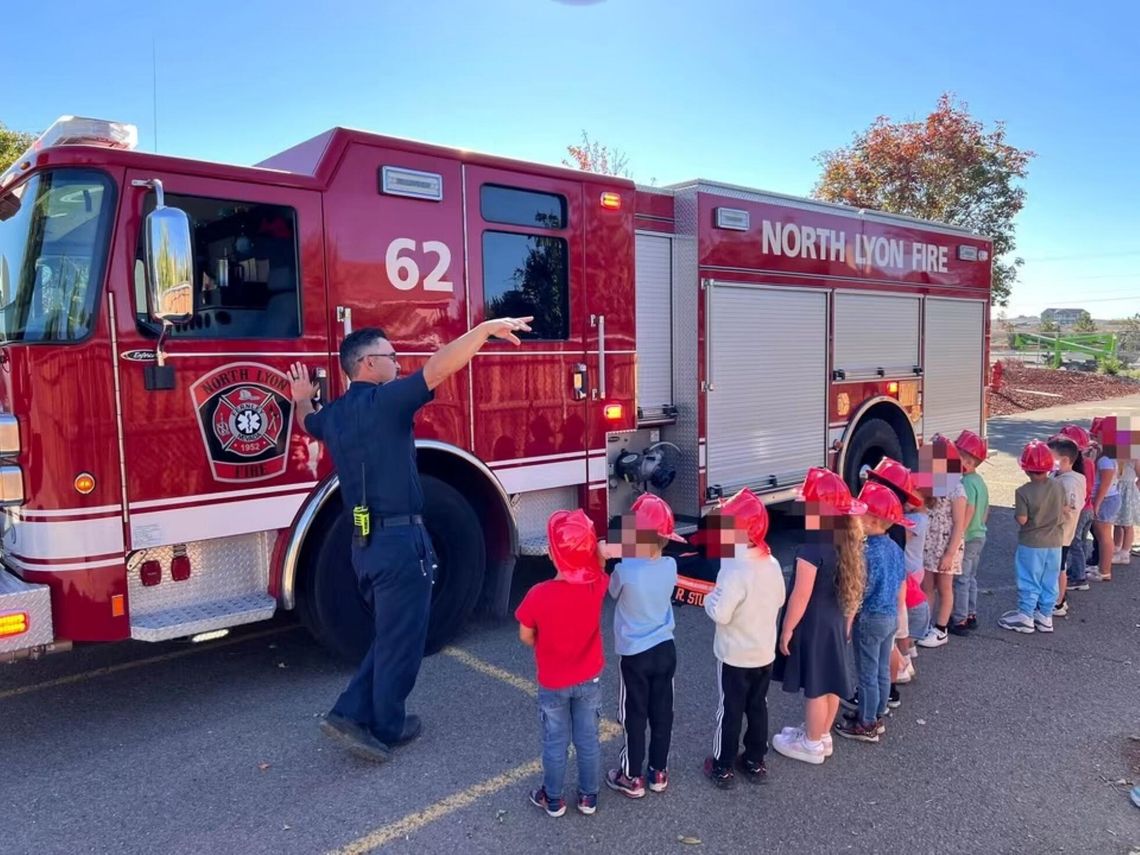
Steve Kuntz knows some business owners worry when the fire marshal walks through the door—the person with the clipboard who might spot a violation or require changes.
As the North Lyon County Fire Protection District’s newly appointed fire marshal, Kuntz is working to change that perception, one conversation and inspection at a time. He is building the district’s business inspection program from the ground up, an initiative he says is vital for community safety and the protection of local crews.
“People fear the fire marshal coming into their business because [they] think they’re going to shut them down,” Kuntz said. “But there’s so much benefit from having us come out and do inspections because it reduces risk and we see things that can be corrected.”
For Kuntz, reducing that risk is personal. He has spent 16 years responding to emergencies with North Lyon County Fire.
Kuntz’s career began in 2008 as a volunteer in Loomis, California, where he earned his basic EMT certification. He moved to Reno to attend paramedic school at REMSA, working shifts as an emergency room technician at St. Mary’s Regional Medical Center to support his education.
By the time he graduated, the Great Recession was squeezing municipal budgets across the country, making full-time fire and EMS jobs scarce. Kuntz worked on ambulance crews at Banner Churchill Community Hospital in Fallon before an opportunity opened in Fernley.
He was hired as one of the district’s first three civilian paramedics, starting in January 2010. Though hired exclusively for medical response, the district soon restructured the roles into dual firefighter-paramedic positions. Within a year, Kuntz earned his firefighter certifications through the department.
Over his 16 years with North Lyon County Fire, Kuntz has held a variety of roles. He took on supervisory responsibilities early as a lieutenant under Chief Darryl Cleveland, tested for and earned a fire captain position under Chief Scott Huntley in 2013, ran the district’s wildland fire program and served as acting assistant chief during the COVID-19 pandemic under Chief Jason Nichol.
“I’m never a big one on position time,” Kuntz said of his changing titles. “I’m a loyal employee and I just want to do the best job I can. Whatever role or capacity, I’m always going to do that.”
Throughout his time on the line, Kuntz continued his education, a standard he encourages new firefighters to follow.
“I always tell the new firefighters, ‘You’ve got to continue your education. You’ve got to get at least one certificate a year.’”
When longtime Fire Prevention Lead Tim Myers retired in January, Kuntz saw an opportunity to change directions. After years of overtime and extended wildland fire assignments, family took priority. With his children now teenagers, the fire marshal role offered regular office hours and more time at home.
“I didn’t want to look back and say, ‘Man, I really wish I had spent more time out there,’” Kuntz said. “This position affords me a good work-life balance while still allowing me to be deeply a part of the community.”
Kuntz handled the interim fire prevention workload before his promotion to full-time fire marshal became official Sept. 21.
Today, he runs the Fire Prevention Division on his own, handling public education, code enforcement, construction plan reviews, permitting and business inspections. Current projects include a new culinary arts center at Fernley High School, an aerosol plant, industrial developments and fire-suppression hood systems for the new fire station.
Kuntz is also preparing for additional training in sprinkler plan review and arson investigation.
Moving from emergency response into a regulatory role meant adjusting to a different kind of pressure: conflict.
“Early on, that was tough, because the first couple weeks I was on my own, I’m like, ‘This is great. I get to go talk to people and people like me,’” Kuntz recalled. “But then when I go, ‘Oh, I think we need to explore this or change this,’ I was like, ‘Oh man, I hope they don’t feel I’m trying to be a pest or flex.’”
As Fernley grows, Kuntz grounds his decisions in the codes adopted by the district.
“I don’t like to enforce my position. I enforce the codes,” Kuntz said. “I can’t issue the permit until you do that. I don’t want to hold the project up, but we need to address these issues. When I relate that decision back to safety, people are super understanding.”
That work brings Kuntz together with Fernley’s planning, building and public utilities departments to address safety before construction begins.
When Kuntz enters a facility, he checks items such as exit lights while also gathering information that could help crews during an emergency. He develops detailed pre-incident plans using a software program called First Due, mapping building layouts, recording after-hours contacts and uploading safety data sheets outlining hazardous chemical risks.
Responders can access that information through mobile data terminals in emergency vehicles.
“If a warehouse has a hidden room in the back, our crews will know to check it,” Kuntz said.
Preplanning is particularly important as south and southwest Fernley and Victory Logistics District develop. Kuntz is identifying response needs in areas lacking infrastructure.
“We already have plans for the south area because there are no fire hydrants on the south side of the canal currently,” Kuntz said. “We know we have to take water tankers down Truckee Lane. Our responders need to have that knowledge in order to do their jobs efficiently.”
He also brings emergency-access concerns to city planning, including traffic around school zones. On Hardie Lane, vehicles lining both sides of the road during drop-off and pickup at Fernley Elementary School can make access difficult.
“What do we do if we had an incident on your property and it’s drop-off time? How do we get our engine to where it needs to be? The more we can pre-plan and identify those things, the safer our responders are,” Kuntz said.
Although his work now focuses on prevention, Kuntz has not put away his turnout gear. If an emergency call comes in and a station is short-staffed, he may join an engine crew.
Shortly after taking the prevention role, Kuntz responded to a fatal structure fire off Scott Drive near Green Valley after hearing that the initial engine had only one person aboard.
Even during a commercial inspection, he said, a life-threatening emergency would take priority.
“If it was someone’s life, I would definitely choose to go,” Kuntz said. “I would have my radio on, say, ‘Hey, I gotta go, I’m sorry, we’ll reschedule.’ Because to me, life trumps everything. That’s the most important part.”
The move into prevention has changed how Kuntz sees his mission.
“When I was a young fireman, I didn’t appreciate fire prevention,” Kuntz said. “You enjoy doing that operational work because you’re helping the community and doing hard physical work. I looked at fire prevention back then and thought, ‘Well, if you prevent all fires, then what are firefighters for?’”
“But now I realize you can’t eliminate the human factor entirely. Fires are still going to happen. But our goal is to minimize that risk together. The firefighters on the trucks might say, ‘We want to go fight fires.’ But the prevention guy is saying, ‘I’m gonna do my best to keep those fires from happening so people don’t get hurt.’ Protecting property from fire loss reduces the ultimate economic hit to our community, ensuring our residents, visitors, and responders all make it home safe.”


Comment
Comments