

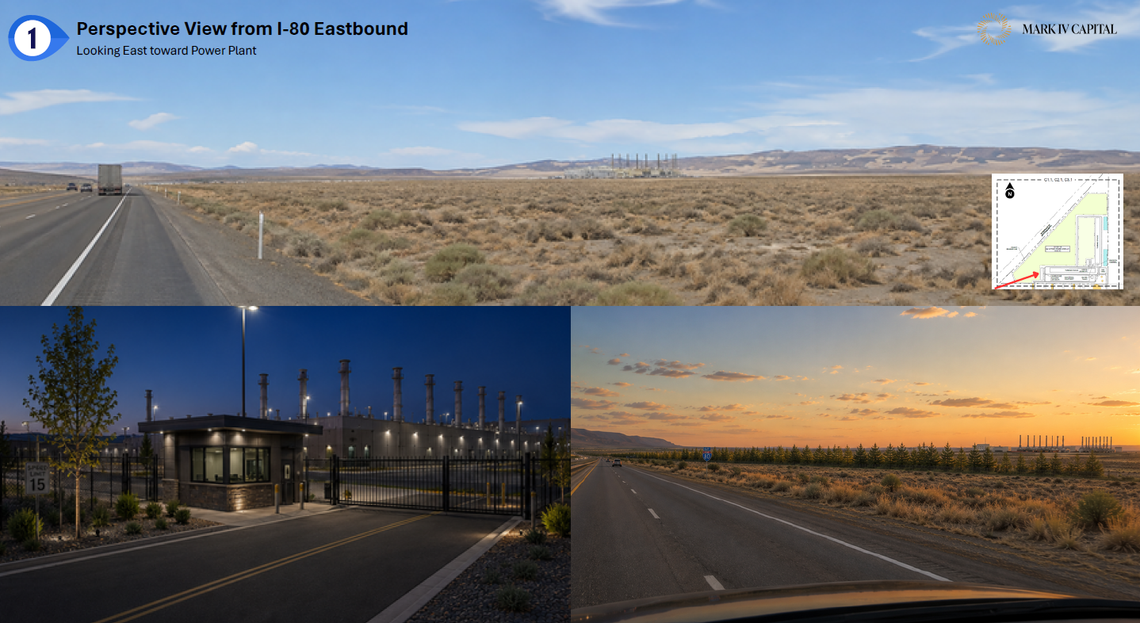
A $600 million power plant promises to bring Fernley two things developers say could fuel its growth: electricity for new industry and an estimated $63.6 million in city revenue over 20 years.
The Fernley City Council voted 4-0 Oct. 7 to approve a conditional use permit for the privately funded, 324-megawatt natural gas-fired plant adjacent to the Victory Logistics District. Dave Snelgrove, a planning manager with Bowman Consulting Group representing the applicant, said the project would supply power sooner than NV Energy can provide it, opening the door to additional industrial development.
A fiscal impact analysis prepared for the applicant by Ekay Economic Consultants, Inc., projects approximately $63.6 million in city general fund revenue over 20 years, including about $20.4 million in property taxes, $43 million in franchise fees and $78,000 in sales taxes. It also estimates $10.5 million in revenue for the North Lyon County Fire Protection District over the same 20-year period.
Developers are counting on the electricity to attract more businesses. Snelgrove said prospective industrial users had walked away because power was not available within a reasonable timeframe. He said the privately funded project would not affect NV Energy customers' electricity rates.
The applicant, M4 Victory Power QOZB, LLC, plans initial development on approximately 50 acres of a 109.06-acre industrial parcel east of Interstate 80. The plant would sit outside, and adjacent to, the Victory Logistics District planned development. Snelgrove said an expansion beyond the approved 324-megawatt project would require another conditional use permit.
Before the plant can begin commercial generation, however, fire and emergency protection must be in place.
The council approved revisions to Condition 35, addressing how the project's demands on emergency services would be assessed, what the applicant would contribute and how protection would be provided.
Chris Molina, the city's outside counsel on land-use matters, explained that the revised language calls for an applicant-funded fire and emergency-service impact assessment before building permits other than grading. It would distinguish existing needs from additional demands created by the plant.
The assessment would examine response times, driving distances from existing and planned fire stations, and specialized equipment and training. It would identify the plant's proportionate share of capital costs and estimate recurring operating expenses attributable to the project.
Building a fire station and buying equipment are different expenses from paying firefighters and operating the station year after year. That distinction was part of the discussion over who would pay for protection.
North Lyon County Fire Protection District Fire Marshal Steve Kuntz supported the revised condition but asked for additional language addressing recurring operating costs, rather than only the applicant's capital contribution.
Before building permits other than grading, the applicant must enter a fire-service agreement with the city. It would require payment, or an equivalent contribution, toward the project's share of identified capital costs, with payment timing and financial security established.
Commercial generation could begin only when a staffed, equipped fire station meets the evaluated standards or an approved interim fire-service plan is in effect. An interim plan would identify staffing, equipment, response times, aid arrangements and funding sources.
The council also approved revisions addressing noise and air quality through Conditions 15 and 39. The approval period for the conditional use permit was extended from one year to three years.
Councilwoman Felicity Zoberski asked about turbine startup noise and acoustic enclosures. Snelgrove said the proposed Solar Titan 130 turbines would meet applicable noise standards even without the enclosures. Planning Director Treston Rodriguez said revised Condition 15 would allow equivalent noise-attenuation measures while retaining the approved noise limits.
Condition 39 addresses Nevada Division of Environmental Protection air-quality requirements. The approved proposal includes up to 36 generating units, with no more than 29 operating at once, and exhaust stacks up to 75 feet high. Snelgrove compared that height with existing industrial silos he said were 83 to 88 feet high. The council also required NDEP air permits before construction of power-generating equipment and council approval of changes in capacity, units, stack height or configuration.
On water consumption, Scott Barnes, Mark IV Capital's vice president for entitlements, emphasized that the generating system is air-cooled and requires no water for cooling. Water would still be needed for landscaping and domestic uses. The council added language requiring city evaluation and approval of demand exceeding already dedicated water before building permits.
Plans include an eight-foot fence topped with barbed wire, a guardhouse and controlled entry. Landscaping is planned along the Interstate 80 frontage and around the office.
Zoberski asked about annual compliance reports and what would happen if the plant closed. City Attorney Aaron Mouritsen said the proposed power district ordinance would require annual reports to council by March 31. That ordinance has not yet been adopted.
Bob Sweetin, an attorney representing Mark IV Capital, said decommissioning would be addressed through environmental permitting and future district service rules. Mouritsen said the power district ordinance did not contain decommissioning language and that the issue would be addressed through contractual obligations.
During public comment, Greg Evangelatos, former city manager, supported allowing three years for the project, saying a development of that magnitude needed time to bring its components together. A statement read on behalf of the Fernley Chamber of Commerce board supported approval, citing construction work, permanent plant employment and jobs at businesses the additional electricity could accommodate. Snelgrove's presentation anticipated first power in late 2029.
The council also held the first reading of Bill 394, proposing to establish the Fernley Power District as a municipal electric utility. The ordinance outlines its initial service area within the Victory Logistics District and its governing board's composition, selection and authority.
The permit approval authorizes development of the plant, subject to its conditions and remaining approvals. The separate ordinance, which still awaits final adoption, would establish the public utility intended to deliver its power.




Comment
Comments