
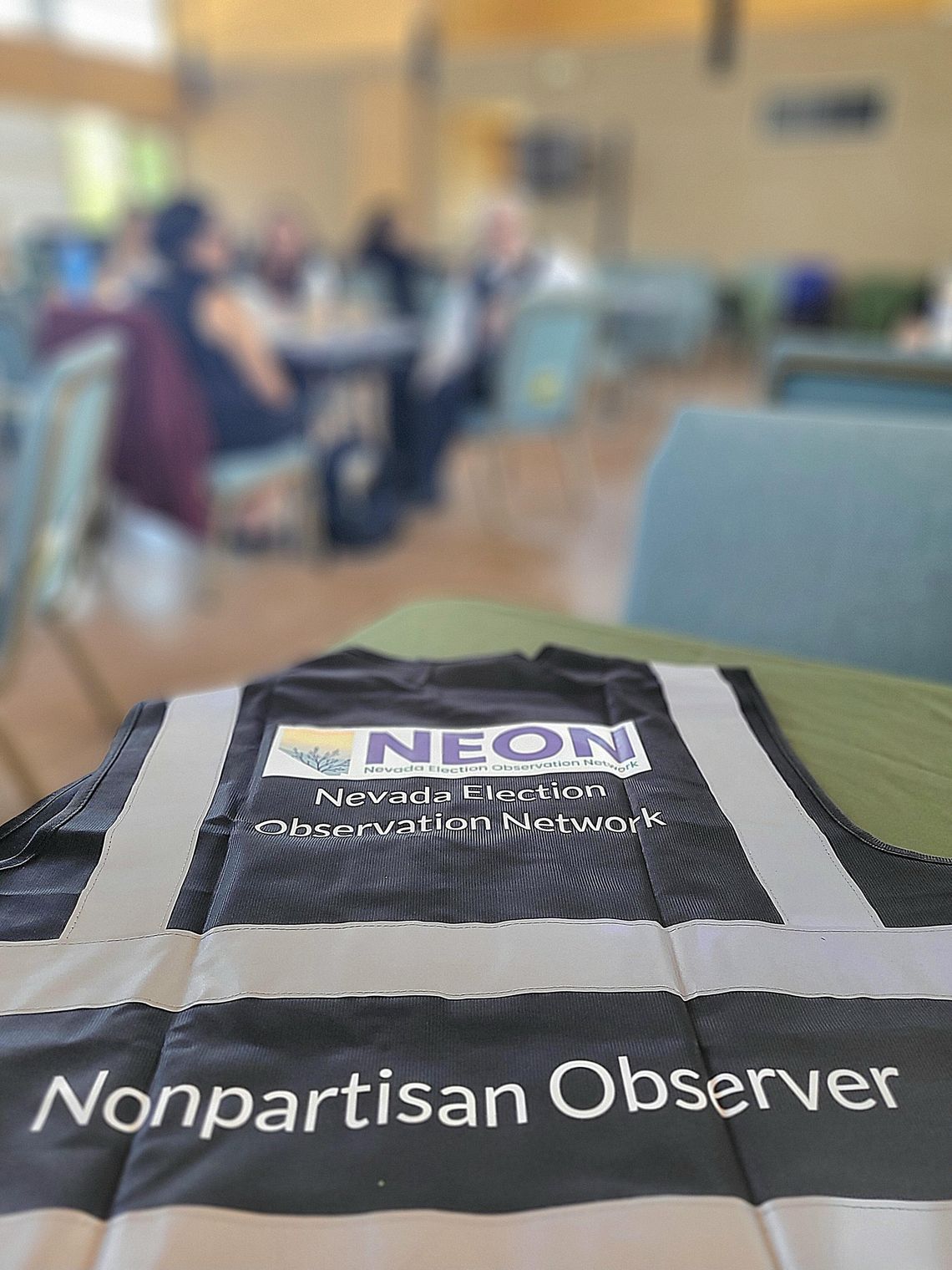
The Nevada Elections Observation Network (NEON) will begin operations this Election Day. NEON is supported by The Carter Center, founded by former President Jimmy Carter and former First Lady Rosalynn Carter.
Established in 2026, NEON describes itself as a Nevada-led, nonpartisan initiative. The organization is financially and technically supported by The Carter Center, which currently serves as its fiscal sponsor and is helping oversee training, recruitment and statewide operations. NEON is guided by a cross-partisan advisory board of Nevada leaders with backgrounds in elections, journalism, Tribal communities, philanthropy and civic engagement. The Carter Center has said its long-term goal is for NEON eventually to operate independently.
NEON’s website lists a five-member advisory board: Tarina Elliott, public relations manager for the Duckwater Shoshone Tribe; Michele Forney, former Help America Vote Act administrator for the Nevada Secretary of State and senior elections expert with The Elections Group; Pat Hickey, a journalist and former Nevada legislative leader; DeWayne McCoy, pastor, founder and CEO of The Foundation Christian Center and The After Market; and Janet Quintero, chief strategy and advocacy officer for United Way of Southern Nevada.
The organization’s work includes “protecting human rights, fostering democratic principles, promoting the rule of law and access to information, tackling neglected tropical diseases, and advocating for people facing issues related to mental health and caregiving.” According to The Carter Center, the organization has conducted humanitarian and election observation work in 90 countries around the world.
In recent years, that focus has expanded in the U.S. through support of election observation networks in states including New Mexico and Montana.
Sarah Johnson, one of The Carter Center’s senior associate directors for the Democracy Program, said the central goal of these efforts involves addressing issues with how elections are administered as well as informing the public about how elections work, from the time voters drop off their ballots until the final count is announced.
“In The Carter Center’s work overseas, we assess all parts of the electoral process and work to increase public understanding and to lend transparency to the process,” Johnson said.
She noted that The Carter Center has seen distrust among the American public toward democratic institutions. As a citizen-led initiative, Johnson explained, “nonpartisan election observation networks have the potential to serve as independent and trusted actors in this field.”
Another reason The Carter Center considers nonpartisan election observation in the United States important is that what happens with elections here can affect perceptions overseas.
“We’re considered the vanguard of democracy in the world, and what happens here also impacts many of the countries in which we work overseas and democracy around the world,” Johnson said.
But why Nevada rather than another state?
Johnson said data from the Massachusetts Institute of Technology’s Election Data + Science Lab show Nevada ranks among the nation’s leaders in election administration. Behind Minnesota, Nevada ranked second in the country for measures including accessibility to the ballot box, election security and processing, security of election systems and voter registration processes.
“Nevada is a great place for us to learn positive lessons from administrators that can be shared in other states where The Carter Center is supporting nonpartisan observer groups,” Johnson explained.
NEON observers will receive training in “applicable laws, procedures and safeguards, and observer responsibilities so that they’re prepared to document everything accurately,” Johnson said.
Observation will include poll worker training, voting equipment testing and mail-in ballot processing. Observers will use standardized questions and checklists to record what they see objectively and consistently across locations. The data collected will then be compiled and analyzed to “produce a public assessment that’s grounded in evidence.”
Johnson clarified that observers are trained not to interfere with proceedings or “proactively engage with voters.”
“Really, their job is to document the process and provide that impartial, accurate account of what happened,” she said.
Johnson emphasized that election observation efforts will extend across Nevada’s counties, with county coordinators assigned to each. NEON is “focusing our recruitment exclusively within those communities,” she said, adding that “most, if not all, of them will be observing within their own communities.”
The goal of The Carter Center is to continue supporting NEON during future election seasons by helping train community volunteers on state election laws, safeguards and procedures. Eventually, Johnson said, the hope is for NEON to become a separate entity capable of operating independently.
That has already happened with an election observation group The Carter Center supported in Montana, which Johnson said became a nonprofit organization this year.
The Carter Center will evaluate NEON after the midterm elections, Johnson said, asking whether “NEON was largely able to observe the election process from start to finish across the state.”
“It would be amazing to be able to have observation in every state,” Johnson said, adding that “our hope is that we can continue to be expanding this work” through the 2028 presidential election.
Johnson said observation networks provide “an important opportunity for people to get engaged beyond political or party identity.”


Comment
Comments