

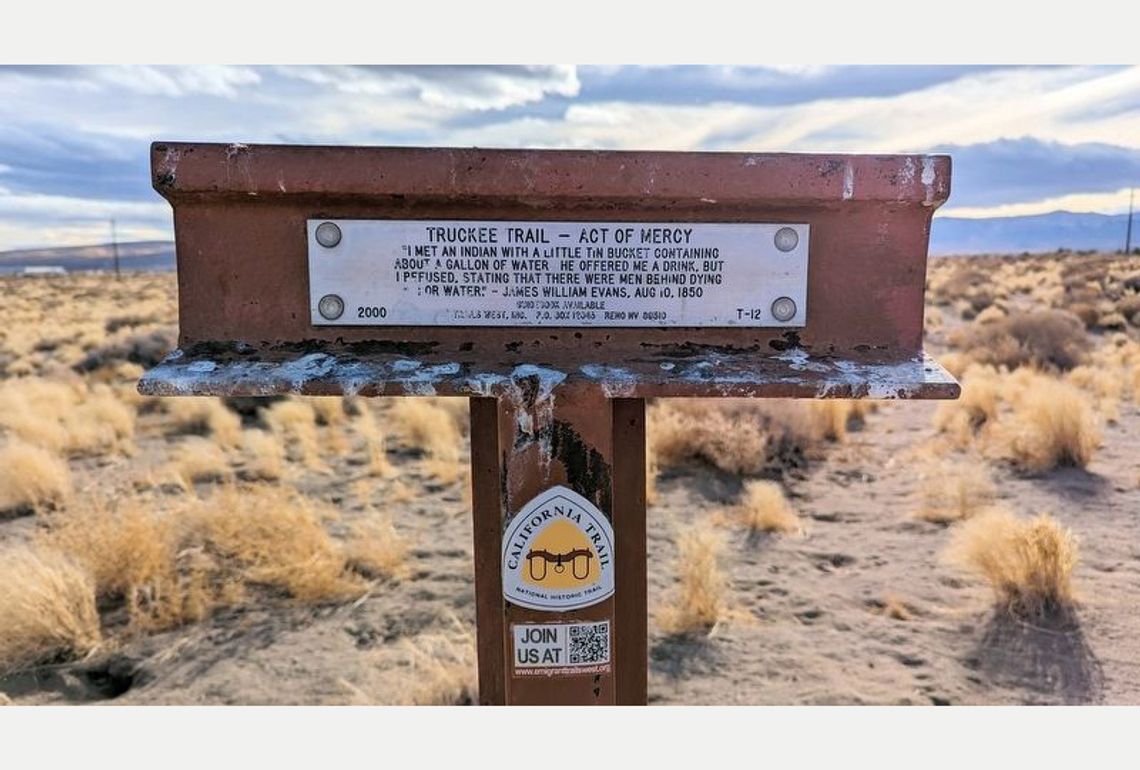
The man had water.
On August 10, 1850, traveler James William Evans encountered a Native man carrying a tin bucket containing about a gallon of water. “He offered me a drink, but I refused, stating that there were men behind dying for water,” Evans recorded.
The Trails West “Act of Mercy” marker on Truck Inn Way in Fernley preserves this encounter: one man offering water, another thinking of those whose need was greater. The account does not give the Native man’s name, but his kindness and his presence belong in the history of this place.
Imagine how much that water mattered after months on the trail. Your children are with you. Beneath the wagon cover are flour, bedding, cooking pots, tools and the belongings you chose for a new life. The wagon holds what you hope will sustain your family, but getting it through depends on the oxen — and on drinkable water.
St. Louis connected travelers to Missouri River outfitting towns such as Independence and St. Joseph, where they prepared for a journey commonly lasting four to six months. Many wagons used four to six oxen and carried so many necessities that travelers often walked beside them. When a team weakened, possessions might have to be abandoned.
Keeping a family moving required endurance, resourcefulness and courage. Disease, especially cholera, took lives along the trails; accidents and river crossings claimed others. Families carried their hopes west knowing that reaching California together was never assured.
Those who survived to reach Nevada still faced the Forty-Mile Desert, where they crossed from Lovelock and the Humboldt Sink toward the Truckee River at present-day Wadsworth. Near Fernley, deep sand demanded still more from exhausted animals, with the Sierra yet to come.
Helen Carpenter’s September 18, 1857, account, preserved on another local trail marker, describes eight miles of deep sand and dead cattle lining the road. Every failing animal narrowed a family’s chances of reaching the water ahead.
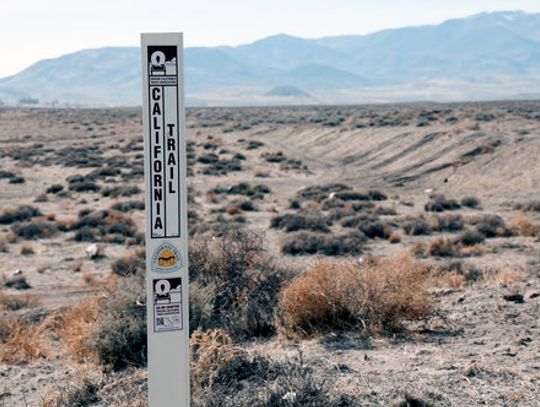
That passage remains written in the ground. The Fernley Swales are long, trough-shaped depressions created by thousands of heavy, iron-bound wagon wheels. The Bureau of Land Management identifies them as the only remaining deep-sand swales on the California National Historic Trail. Beside those hollows, we can picture children walking and parents watching their animals struggle.
The people watching those wagons arrive had children to feed, too.
Northern Paiute families had lived in this region for thousands of years; Pyramid Lake was — and remains — a Paiute homeland. Washoe homelands included Lake Tahoe and neighboring valleys. Seasonal movement connected families with fishing, hunting and gathering places.
The Reno-Sparks Indian Colony’s history describes how pioneer newcomers mistook those movements for aimless wandering. They failed to recognize a way of life sustained by generations of knowledge, even as Americans were hearing another story about taking the land.
In 1845, editor John O’Sullivan invoked “manifest destiny to overspread the continent allotted by Providence.” His language gave expansion the authority of God’s purpose. For families seeking a new beginning, that promise could be compelling. But claiming divine approval did not answer a simple moral question: What right did newcomers have to take another family’s home?
Readers raised on the Good Samaritan and “Thou shalt not steal” will recognize the tension. A Native man offered water to a stranger, while the promise of a continent supposedly allotted to European Americans left little room for his own people’s rights.
As migration and settlement grew, newcomers occupied land and consumed resources that Native families depended on. The Colony’s history describes depleted food supplies and growing hunger, and how resistance to removal and assimilation brought accusations of hostility. Think what that meant for parents who knew where food had always been found but could no longer depend on it to feed their children.
Assumptions of white superiority helped excuse dispossession. Calling it progress did not make the hunger less real or the taking of a homeland less devastating. The emigrants’ courage deserves remembrance, but their suffering cannot excuse the suffering inflicted on people already here.
As Regent of DAR’s Fort Churchill Chapter and Nevada DAR State Historian, I believe preserving history requires hearing the accounts of people whose lives were changed by it. Our chapter carries a fort’s name; that creates an obligation to understand the whole story.
Patriotism and historical honesty are not opposites. We honor our history by looking directly at it, including the harm and the voices too often ignored.
Paiute and Washoe people remain our neighbors, carrying histories that do not end with the arrival of wagons. What changes in our own understanding when we hear their accounts alongside those of the families who came west?
The man who offered a stranger water deserves a place in our memory and in this history. The land newcomers were pouring into was already someone’s home.




Comment
Comments