
Fernley residents trying to follow Wednesday night’s City Council meeting could be forgiven for wondering how a proposed power plant, a new fire station, a municipal electric utility, a Planning Commission dispute and several competing interpretations of City code all became part of the same conversation.
Underneath all of it is a simpler question:
How does Fernley accommodate a large industrial development while making sure the public infrastructure needed to serve it is built, funded and operated?
The City Council will take up two related matters Wednesday: the proposed Fernley Power District and CUP26005, the conditional use permit for a proposed power-generation facility associated with the Victory Logistics development.
Both could have significant long-term consequences for the city.
Why Victory matters
Victory Logistics is intended to bring large-scale industrial development to the community.
The proposed power plant is important to that development because large industrial users require large amounts of reliable electricity. Victory representatives argue that obtaining sufficient power through the existing utility system on the timetable required by prospective users has become a major development constraint.
Their proposed solution is a generation facility and a municipal electric utility — the Fernley Power District — capable of serving large loads within the Victory area.
The financial implications could also be substantial.
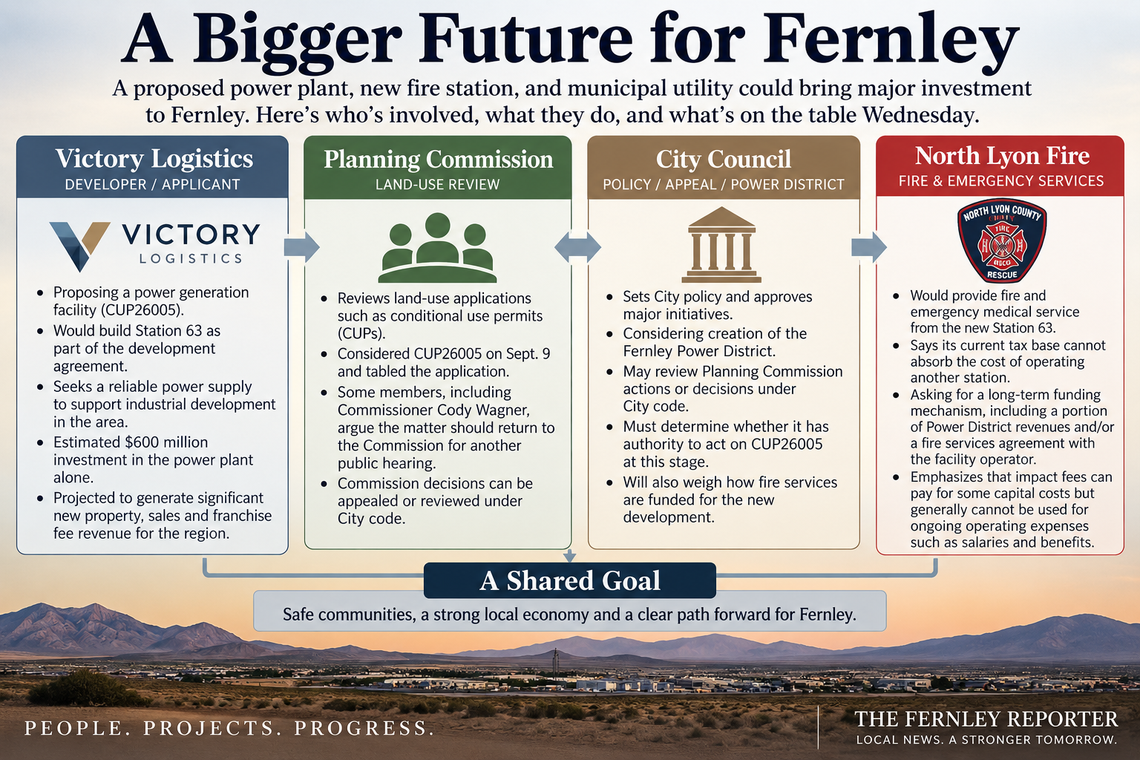
A fiscal impact analysis prepared for the 324-megawatt power project estimates approximately $43 million in City franchise-fee revenue over 20 years at a one-percent rate. The same analysis projects about $10.5 million in property and sales tax revenue to North Lyon County Fire Protection District over that period.
Those are projections rather than guaranteed revenues, and the assumptions illustrate why the outcome matters beyond one developer or one project.
The proposed development represents new taxable property, new utility revenue and the potential for additional industrial investment in Fernley.
Victory representative Rick Nelson has described the power plant alone as an approximately $600 million investment.
Then comes the fire station
Large-scale industrial development also creates demands on public services.
Station 63 is being constructed in the Victory Logistics area to provide fire and emergency response closer to the development.
That is where much of the present disagreement begins.
Victory’s position is that the existing development agreement assigns the developer responsibility for constructing the station while the City is responsible for providing or causing fire service to be provided from it.
North Lyon Fire would provide that service.
Fire Chief Brian Bunn says his district cannot simply absorb the cost of staffing and operating another station from its existing revenue base.
He has asked the City to establish a long-term funding mechanism for personnel, apparatus, equipment, training and other operating costs associated with Station 63 and the industrial area it would serve.
The parties increasingly appear to agree on the outcome: a staffed and equipped station needs to be operating before the proposed power plant begins commercial operation.
The argument is over how that happens and who pays the recurring bill.
North Lyon Fire is asking for a portion of revenues generated by the proposed Power District and has also suggested a long-term fire-services agreement with the operator of the generation facility.
Victory has maintained that construction and operating costs are separate obligations and that recurring fire service ultimately must be worked out between the City and Fire District.
Impact fees and similar development tools can be used for certain capital facilities but generally cannot simply become a permanent source of firefighter salaries and operating expenses.
Who gets to decide the CUP?
While those negotiations continue, another dispute has emerged over who should hear the power plant’s conditional use permit.
The Planning Commission heard CUP26005 Sept. 9 but tabled it instead of approving or denying it.
North Lyon Fire and Planning Commissioner Cody Wagner argue that means the application should return to the Planning Commission.
Wagner has formally objected to the City Council taking up the matter now, sending a letter to the city on Monday. His argument is that Fernley delegated authority over conditional use permits to the Planning Commission and that the Council generally becomes involved after a Planning Commission decision is appealed.
Victory interprets the City code differently.
Fernley’s general appeal provisions refer to review of a Planning Commission “action or decision.” Victory argues that the Commission’s vote to table the application was itself an action and therefore can be reviewed by Council.
That is not merely semantics.
Fernley’s development rules give the Planning Commission a formal decision-making role on conditional use permits, while other provisions provide for City Council review of Planning Commission actions and decisions.
The City Attorney may ultimately have to explain how those provisions fit together.
A separate fairness argument
Victory has also raised another issue.
Nelson says the company does not believe it can receive a fair hearing if the CUP is returned to the current Planning Commission, citing statements and actions by Wagner that Victory believes show he has prejudged the application.
Wagner has declined to recuse himself and has sought review of his conduct by state ethics authorities.
Victory argues that an applicant in a quasi-judicial land-use proceeding is entitled to an impartial decision-maker.
That claim has not been adjudicated, and accusations of bias should not be confused with a formal finding of wrongdoing.
But it explains why Victory is pressing for Council review rather than simply returning to the Planning Commission.
Three institutions, three jobs
Some of the confusion surrounding the project comes from the fact that three separate public bodies are involved.
The Planning Commission administers portions of Fernley’s land-use process and considers applications such as conditional use permits.
The City Council writes City law, approves major policy decisions and hears certain land-use appeals or reviews.
The North Lyon County Fire Protection District is a separate governmental entity responsible for providing fire and emergency medical service.
Those institutions have different legal authority and different financial responsibilities.
The present conflict is partly the result of those responsibilities colliding.
The Planning Commission is focused on land-use approval.
The Fire District is focused on whether it can safely and financially provide service.
The City Council must consider broader City policy, infrastructure and finances.
Victory, meanwhile, is trying to obtain the governmental approvals necessary to proceed with a large private investment.
The question for Wednesday
There are legitimate public-safety questions here.
There are legitimate procedural questions.
There are also legitimate economic-development consequences if major projects face long delays while public agencies determine responsibilities that could have been established earlier in the process.
The most useful question for residents Wednesday may therefore be less about which side is “right” and more about whether Fernley’s institutions can establish a clear path forward.
Can the City determine who has jurisdiction over CUP26005?
Can the City and Fire District agree on how Station 63 will be staffed and funded?
Can Victory meet clearly defined public-safety conditions?
And can those decisions be made soon enough to give both residents and investors confidence that Fernley’s development rules mean what they say?
Those are questions the City Council has an opportunity to begin answering Wednesday night.
The Fernley City Council meets Wednesday, Oct. 7, at 5 p.m. at City Hall. The meeting is open to the public, and the City also provides remote participation information with its posted agenda.



Comment
Comments