

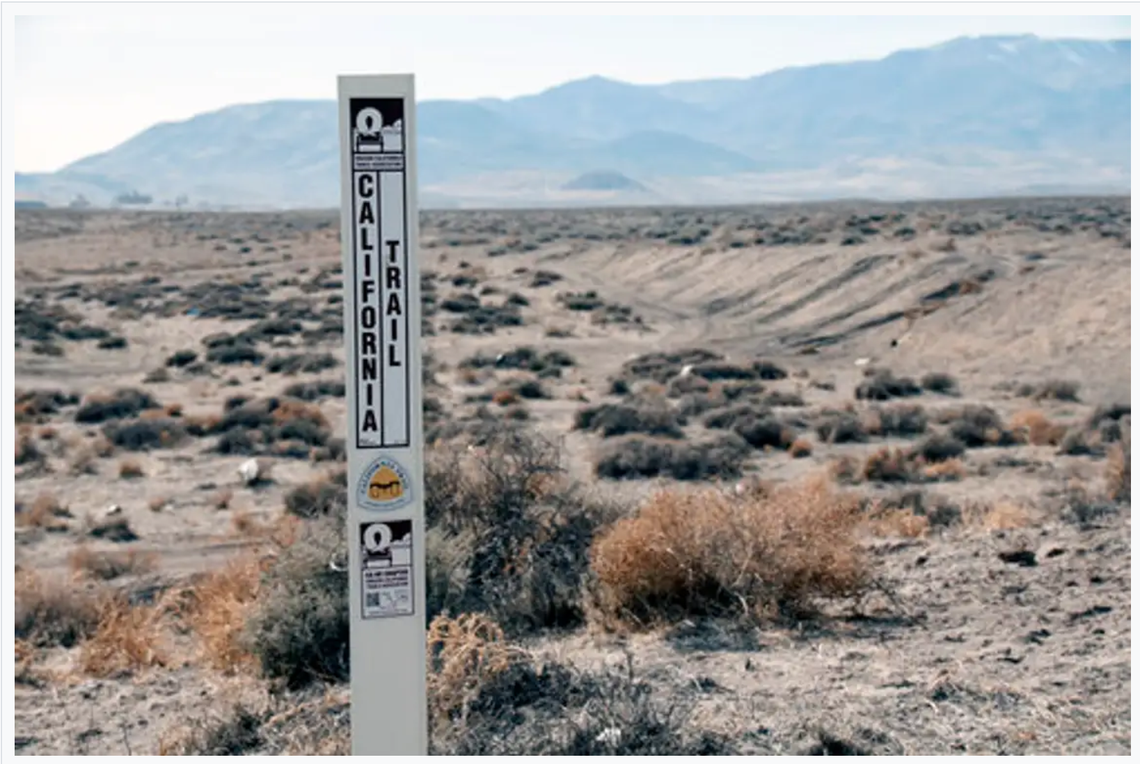
On Oct. 3, the Oregon-California Trails Association holds its annual Fernley Swales cleanup, helping preserve a piece of history visible in the sand.
What are the swales? They are long depressions worn into the land by thousands of emigrant wagons and oxen traveling the California Trail in the 19th century.
Standing there, it is easy to imagine families moving their belongings and hopes westward. It takes another moment to imagine watching those wagons arrive.
For the Northern Paiute people, this was home. The Pyramid Lake Paiute Tribe traces its presence here through thousands of years. Generations understood the lake, river and surrounding country through the foods they provided and the seasons that governed their availability. Fishing and gathering depended on knowledge of where to go, when to harvest and how to live with what the land could sustain.
The wagons crossed that living landscape. What travelers needed along the way was already essential to someone else.
As migration and settlement increased, pressure on those resources grew. The silver discoveries of 1859 brought another rush of newcomers. The National Park Service describes prospectors claiming water, feed and land without regard for Paiute rights. Even Pony Express stations occupied water sources on which Native people depended.
For newcomers, these were opportunities and improvements. For Paiute families, they could mean losing access to food and water. The balance that supported their lives was being disrupted by people who often treated the country as theirs to claim.
Violence accompanied that expansion. One account brings its human cost painfully close.
In her 1883 book, Life Among the Piutes: Their Wrongs and Claims, Sarah Winnemucca Hopkins describes two Paiute girls, about 12 years old, who went out to gather roots and disappeared. Their families searched. Tracks led to the Williams brothers’ trading station on the Carson River, but the men denied knowing where the children were.
Winnemucca recounts how a visiting Paiute man eventually heard the children’s voices. Relatives returned and demanded their release. Beneath a trapdoor, their father found the girls with their mouths bound with rags. He brought them out. The rescuers killed the brothers and burned the building.
Historical accounts differ in details. The Pyramid Lake Paiute Tribe’s war timeline also records the rescue of two young Paiute captives at Williams Station. Their captivity belongs in any explanation of the attack. Beginning with the deaths of white men leaves readers without the events that preceded them.
The violence widened into the Pyramid Lake War of 1860. Volunteers led by William Ormsby marched toward Pyramid Lake. On May 12, Paiute warriors defeated them near present-day Nixon. A larger force of volunteers and regular Army troops returned in June. Nevada’s historical marker describes Paiute warriors holding back that force while women, children and elders escaped.
The marker remembers Numaga as a leader who wanted peace and fought to defend his people. They were defending their homeland.
Fort Churchill followed. Construction began beside the Carson River in July 1860. The Army remained until 1869.
The fort provided practical benefits to the growing settlements. Soldiers guarded travelers and communication routes, protected the Pony Express and telegraph, and intervened in miners’ disputes. During the Civil War, the post helped maintain federal authority in the region.
Those services also supported the expansion that was transforming Paiute lives. Troops fought Native people, and the fort strengthened the government’s ability to suppress Indigenous resistance and assert control over their homeland. Its promise of security meant different things depending on which side of that expanding authority a family stood.
As regent of DAR’s Fort Churchill Chapter and state historian, I work from a simple premise: We need to hear all stories, all histories. Preserving our past means making room for accounts that have been overlooked, including those of the Paiute people whose homeland surrounded the fort.
Our chapter and the Rotary Club of NW Nevada, both based in Fernley, have collaborated on educational library displays to bring local history into view. Maureen at the Pyramid Lake Museum recommended including Winnemucca’s book and Ferol Egan’s Sand in a Whirlwind: The Paiute Indian War of 1860. They offer readers places to begin exploring beyond the familiar outlines.
The Pyramid Lake Paiute Tribe Museum and Visitors Center in Nixon offers another beginning. Paiute people are our neighbors, carrying their history forward through families, cultural knowledge and the continuing care of their homeland. Their perspective belongs in the story we tell about this place.
The swales preserve the passage of the wagons. Fort Churchill preserves evidence of the military power that followed. Between them lies a history of hope, intrusion, violence and survival that deserves to be understood together.
When we look at those tracks in the sand, we can remember the families who passed through. We can also remember the families who were already home.



Comment
Comments