

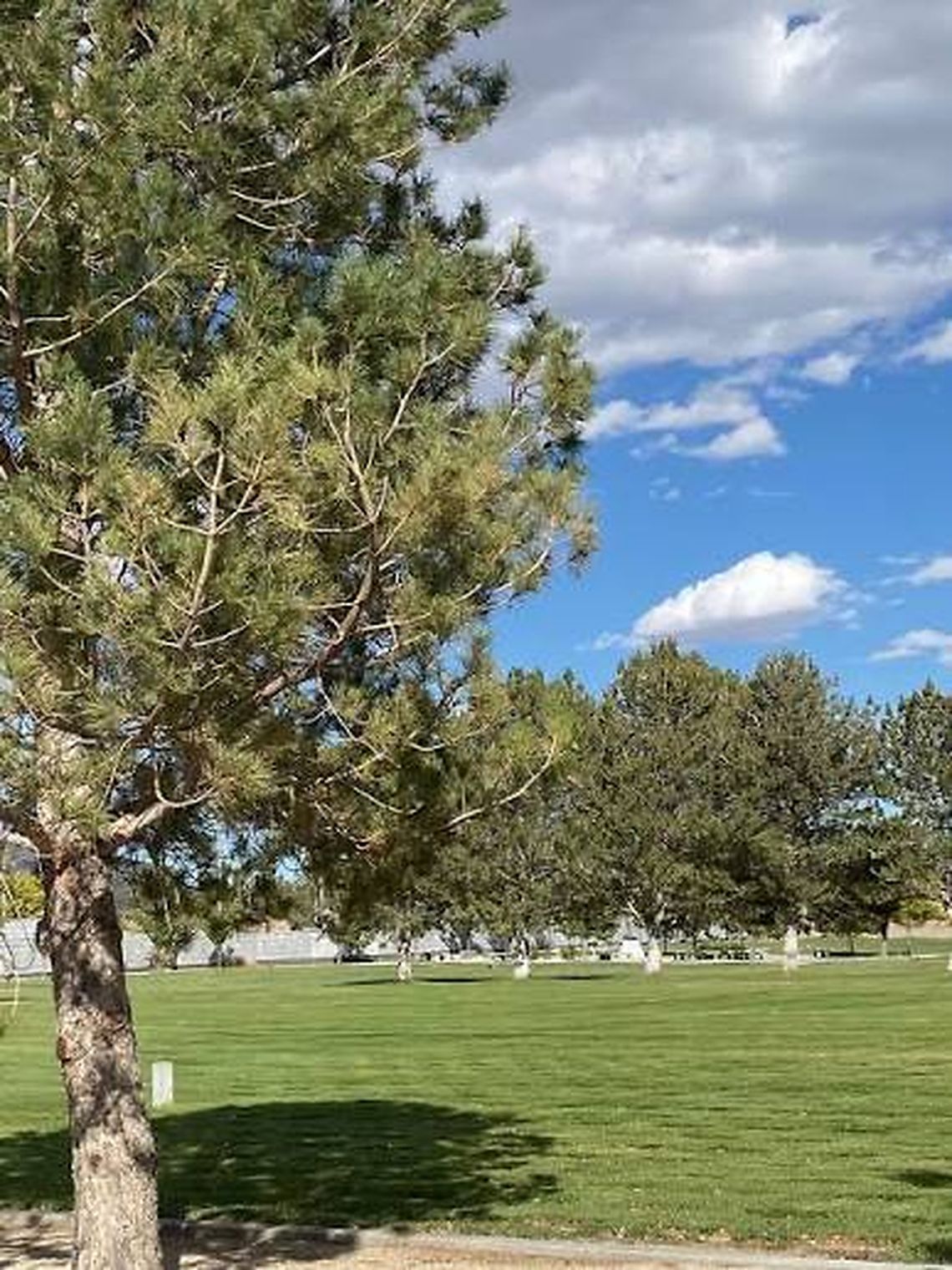
Fernley is developing a long-range master plan for the city cemetery that would gradually transform the largely undeveloped site into a more inviting, landscaped and park-like space while expanding burial options and planning for future growth.
Stephanie Sloan of Sloan Consulting Group said her firm, along with subcontractors CivisWorks and WC Frye Design, has spent the past several months reviewing the cemetery’s history, burial records, property records and existing conditions.
The goal, she said, is to develop a phased plan that improves the cemetery over time without requiring a major upfront investment.
The planning effort grew in part from concerns raised by residents about the condition of the cemetery, including maintenance issues and the relatively barren appearance of the property. Sloan said those concerns have also led to volunteer cleanup efforts and other recent improvements.
“There’s an arc of improvement that we’re really excited by,” Sloan said.
About 50 residents responded to an initial community survey identifying priorities for the cemetery master plan.
One of the central recommendations is to improve the appearance and experience of the existing burial area through relatively simple landscaping features, including trees and small landscaped areas that would help break up the broad views across the desert.
Rather than looking across an open, largely undeveloped site, Sloan said the idea is to create more defined spaces and visual focal points that give visitors a greater sense of privacy and reflection.
The plan would also change the cemetery’s entrance and circulation.
Currently, visitors park near a closed vehicular gate and a pedestrian gate that may appear closed even when it is unlocked. The proposed concept would create a more defined boulevard entrance and destination area, improving both vehicle and pedestrian access.
The existing parking area could eventually be converted into a landscaped burial area with turf, creating what Sloan described as an “oasis” effect as visitors approach the cemetery from Mission Way.
Planners are also looking at adding approximately 10,000 burial spaces over time.
That would be far more inventory than the cemetery currently needs. Sloan said only about 10 cemetery plots are sold annually, even though there are roughly 270 deaths each year among Fernley residents.
One reason for that gap may be the high rate of cremation in Nevada, where Sloan said as many as 70 percent of people choose cremation.
The master plan therefore includes additional options specifically designed for cremated remains, including smaller columbarium structures similar to the larger cremation walls at the nearby Northern Nevada Veterans Memorial Cemetery.
Those facilities could provide families with a permanent place for cremated remains, as well as a memorial wall or marker where a loved one’s name could be preserved and visited.
Sloan said the final master plan will divide proposed improvements into short-, mid- and long-term phases.
Rather than recommending a large one-time expenditure, the plan is intended to identify relatively low-cost improvements that can have an immediate impact.
Trees, landscaping and improved access are among the types of early projects being considered.
“We don’t want to recommend just spend $10 million on this,” Sloan said, noting the city has many competing priorities and cemetery use remains relatively low.
The planning team is also looking at how the cemetery fits into Fernley’s broader growth plans.
The cemetery lies within the city’s north area, where future residential, mixed-use and open-space development is expected. Sloan said planners are considering how the cemetery could eventually function as a green, park-like anchor as surrounding areas develop.
The city is continuing to gather public input before the plan is refined and presented to the City Council.
Residents attending open houses have also been given an opportunity to submit written feedback through an online survey.
The final master plan is expected to provide the city with a phased roadmap for improving the cemetery while expanding burial and cremation options for future generations.


Comment
Comments