
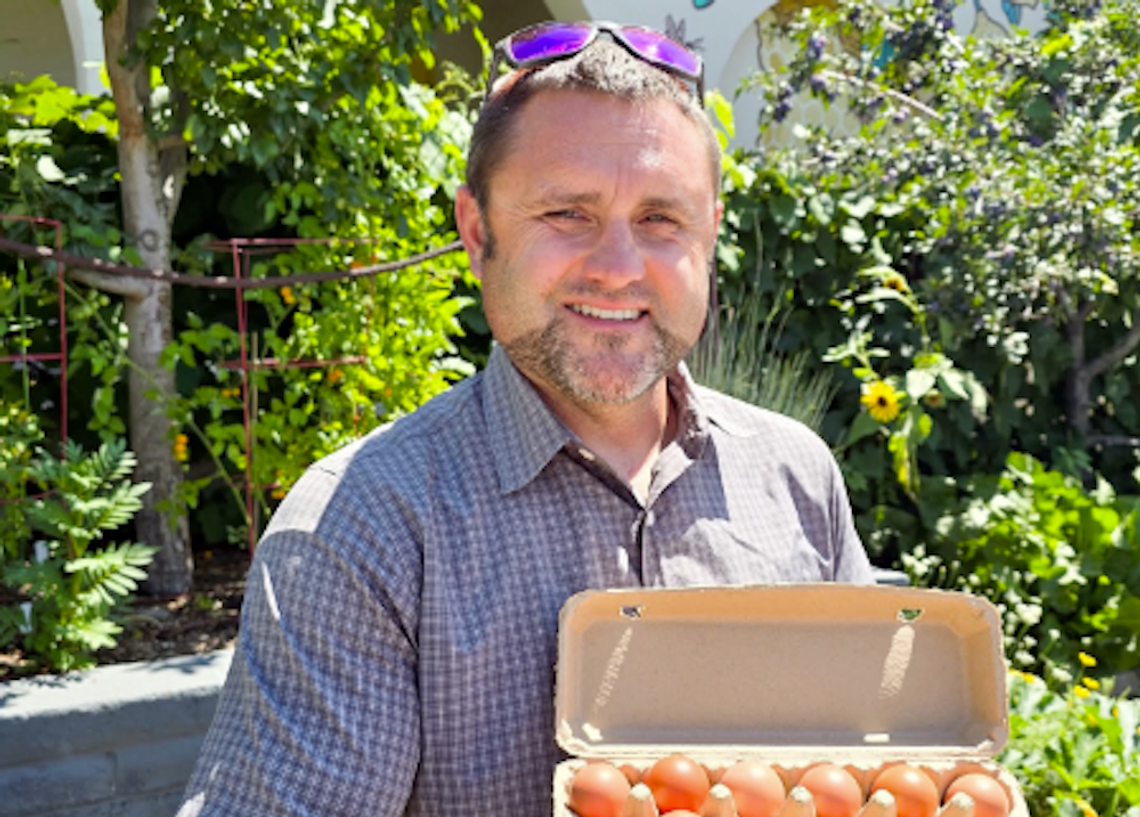
Fallon farmer Joe Frey has spent the past several yeacars changing the way he farms, moving away from conventional tillage and chemical inputs toward regenerative agriculture — and most recently adding more than 1,600 laying hens to the operation.
Frey discussed the transition during a recent Rotary presentation, explaining that his move into regenerative agriculture began not with environmental concerns, but with economics.
Coming out of drought, Frey said more than half of the family farm needed to be put back into production, a project he estimated would have cost about $1.5 million using conventional methods.
“I didn’t have the million and a half bucks, didn’t have the equipment, didn’t have the time,” he said.
He began looking at minimum-tillage and no-till farming and attended a presentation by soil health educator Ray Archuleta. What began as an effort to cut production costs quickly developed into a broader shift in how Frey thought about farming.
Today, he said, the operation has been primarily no-till or minimum-till for about seven years. The farm has also become certified organic and incorporates principles promoted by organizations including the Savory Institute and Regenified.
Rather than growing single crops year after year, Frey now emphasizes plant diversity, reduced soil disturbance and the integration of livestock.
“You don’t ever find a monocrop in nature,” he said.
Frey said diverse plantings help build healthier soils and can make crops less susceptible to insects. His fields may contain alfalfa, grasses, brassicas, chicory, clover, sorghum, peas, buckwheat and other species.
The goal is to keep living roots in the soil, protect the biological community beneath the surface and allow plants, animals and microorganisms to work together.
Livestock are a key part of that system.
Frey began adding laying hens this year, starting with 500 birds in February. Those hens are now producing roughly 350 eggs per day. Another 500 birds are nearing laying age, and an additional 650 are expected to begin producing around the first of the year.
The chickens live in mobile shelters and are rotated through fields behind electric net fencing.
The eggs provide income, while the birds provide another benefit: manure and biological activity returned directly to the soil.
“The cash crop, I guess, in that instance would be the eggs, and then the manure in the field is the benefit of the chickens,” Frey said.
The birds forage throughout the fields during the day, eating insects and whatever else they find — including, Frey said, small fish and crawdads from irrigation ditches — before returning to their shelters in the evening.
Frey farms about 1,500 acres, roughly 1,000 of them irrigated and primarily in alfalfa, with another 500 acres of dryland.
Changing the system has not been without challenges.
Traditional hay buyers often want pure alfalfa, making mixed grass-and-alfalfa hay harder to market even when feed tests show strong nutritional value. Frey said organic dairies may provide a better market because their certification requires some grass and pasture in their feeding programs.
The egg business, however, has shown promise.
Most of the farm’s current egg production is being sold through Great Basin Community Food Co-op in Reno, with smaller quantities going to Fallon restaurants, including Wild Horse Cafe.
Frey said his immediate goal is to continue expanding the egg operation while strengthening the farm financially after several difficult years in the hay market.
“I think we’ve got the knowledge and the capability to do it,” he said, “and we can provide some really healthy protein to the area.”
For Frey, regenerative agriculture ultimately comes down to rebuilding a closer connection between people, food and the land producing it.
“I think it’s time to get smaller, scale it down, get closer, get more intimate with our food,” he said.



Comment
Comments