

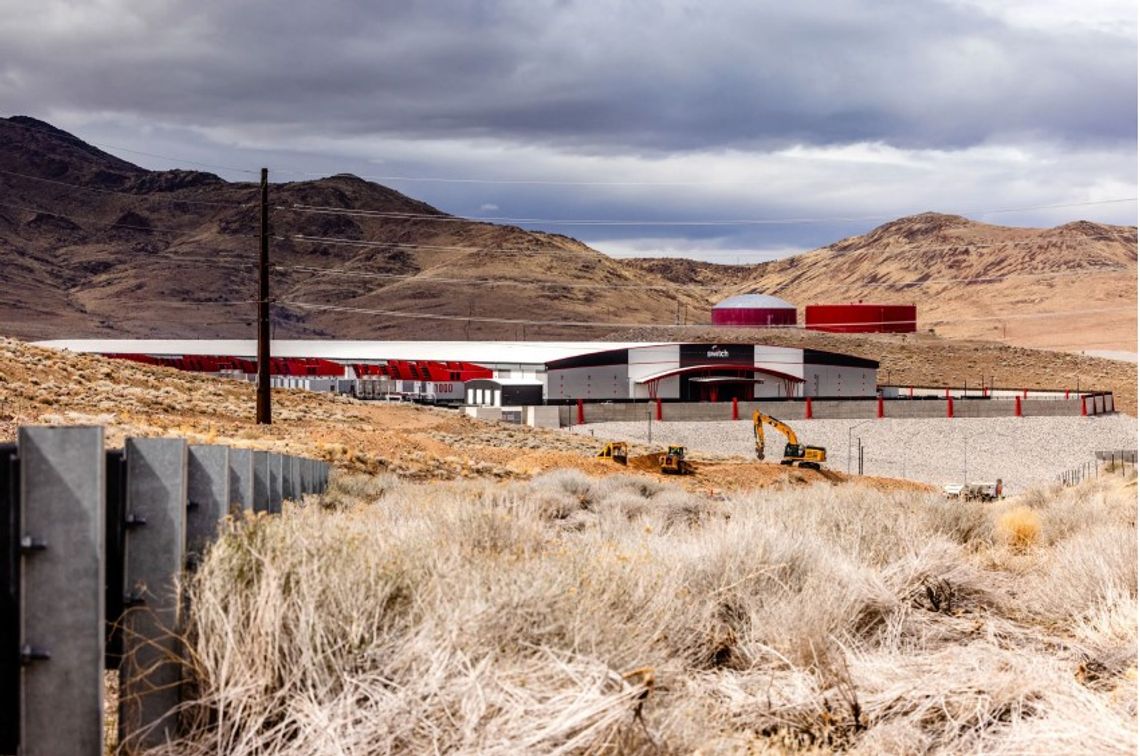
The debate over data centers in Nevada is becoming increasingly polarized.
To hear one side tell it, they are economic salvation: billions of dollars in investment, badly needed tax revenue and infrastructure development.
To hear the other, they are resource-hungry industrial projects that consume enormous amounts of power and water while leaving communities to deal with the consequences.
Boulder City Mayor Joe Hardy offered a more useful way to look at the question during a recent appearance on Nevada Newsmakers.
Don’t start with whether data centers are good or bad. Start with the deal.
Boulder City finds itself in an unusual position. According to Hardy, roughly one-third of the city’s budget is supported by revenue from solar-field leases. The city has historically preferred leasing land rather than selling it, using those payments to fund municipal operations.
And now data centers have entered the conversation.
Hardy said a company associated with Townsite Solar 2 originally held an option to lease Boulder City land for additional solar generation and battery storage. As interest in data centers grew, the company began exploring whether one could be developed there instead.
At the same time, the company had separately sought federal approval for a data center on Bureau of Land Management property within Boulder City’s boundaries.
That is where things became complicated.
Hardy said the BLM ultimately approved the use based on an environmental review originally conducted for solar generation and battery storage.
Boulder City is now suing the agency, arguing that a data center requires a different environmental review. Hardy’s objection is also financial: because the land is federally owned, Boulder City could be responsible for police, fire and other services without receiving the lease revenue it would collect from a project built on city land.
Hardy is not arguing that Boulder City should reject data centers. In fact, he believes a properly structured project could help solve looming city budget shortfalls.
His position is essentially this: if a community is going to accommodate a major industrial development, the community should receive a measurable benefit in return.
Hardy said a November ballot question will ask residents whether the city should consider energy-related development in Eldorado Valley, potentially including a data center.
The interview also addressed the three concerns now following nearly every Nevada data center proposal: power, water and noise.
On power, Hardy said Boulder City’s municipal utility gives the city leverage other jurisdictions may not have. Any data center would need a power purchase agreement establishing where its electricity will come from.
More importantly, Hardy said the city could structure an agreement so some of the revenue generated by the project helps offset residents’ power costs.
That is a much different proposition than simply adding a massive new electrical customer and hoping existing ratepayers are not affected.
On water, Hardy was equally direct: a closed-loop cooling system would be mandatory from his perspective.
On noise, he dismissed much of the concern surrounding newer facilities, arguing that modern data centers are different from earlier generations.
Hardy’s larger point was that the debate does not have to be reduced to simply supporting or opposing data centers.
He pointed to criteria developed by the Sierra Club as an example of how communities could set conditions for acceptable projects. In Boulder City, Hardy said that would mean requiring a closed-loop water system, requiring the developer to secure its own power through a power purchase agreement and structuring the deal so the city receives a direct financial benefit.
For Boulder City, the financial piece is especially important. Hardy said the city is anticipating budget shortfalls within the next five to 10 years, and revenue from a properly structured land lease could help fill those gaps while allowing the city to maintain current services.
His argument was not that every data center is a good deal, but that one meeting strict requirements on water, power and environmental impacts could be.
That is a useful distinction as more Nevada communities are asked to consider these projects.
Large industrial developments can transform a tax base, but they can also strain infrastructure and consume scarce resources if agreements are poorly structured. The real question is not simply whether a data center is coming, but what conditions a community puts in place before it says yes and whether the benefits are substantial enough to justify the demands the project will place on local resources and services.
Hardy’s approach offers a useful framework: require a project to prove its value. Protect the water. Protect existing ratepayers. Account for public-service costs. Require environmental review appropriate to the project being built.
That puts communities in a stronger position to negotiate with a clear understanding of the value of their land, water, power and infrastructure.
State leaders may welcome data centers, but it will fall largely to local officials to make sure their communities and ultimately Nevada, benefit from them.




Comment
Comments