

After nearly six hours of presentations, commissioner discussion and public comment Monday, the Lyon County Board of Commissioners directed county staff to revise a proposed ordinance intended to regulate future data center development.
The board voted 5-0 to return the draft to staff for additional work. Although portions of the motion were difficult to hear because of overlapping conversation in the meeting recording, commissioners clearly identified residential setbacks, cooling systems, air quality, emergency generators and differences between smaller data centers and hyperscale facilities as areas requiring additional attention.
The workshop was held as Lyon County faces increasing interest from data center developers and prepares to consider a separate zoning application for the proposed Monarch data center in Mason Valley.
Community Development Director Gavin Henderson said data centers are currently treated under county code as warehouses, a classification that does not adequately address their electrical demand, cooling systems, backup generation, battery storage and other operational characteristics.
The proposed ordinance would require data centers to obtain conditional use permits in Lyon County’s light industrial, heavy industrial and service industrial zoning districts. That would allow each proposal to be reviewed individually based on its size, location, infrastructure needs and potential effects on surrounding properties.
Henderson said the county examined ordinances and development standards used in several major data center markets, including communities in Virginia, Arizona and Pennsylvania.
“We want to be ahead of the future applications before they come in,” he said.
The draft would require developers to submit detailed site plans and studies addressing electricity demand, noise, traffic, water, wastewater, emergency response, landscaping, fiscal impacts and eventual decommissioning.
The electrical study would have to identify the project’s anticipated demand at each phase of development, available transmission and distribution capacity, necessary infrastructure improvements, construction timelines, costs and potential effects on customer electric rates.
Developers would also be required to document coordination with the applicable utility provider.
Jeff Brigger, vice president of business development and programs for NV Energy, told commissioners the utility is experiencing unprecedented demand from large projects.
NV Energy currently has requests totaling approximately 22,000 megawatts of new electrical demand, Brigger said. By comparison, the utility’s statewide peak demand in 2025 was approximately 8,500 megawatts.
Much of the requested new demand is being driven by data centers, he said.
Brigger said NV Energy is proposing a new large-load electric service agreement through its integrated resource planning process. The proposed agreement would require major customers to make long-term commitments and pay for the generation, transmission lines, substations and other infrastructure needed to serve them.
“The customers that create the need for new infrastructure are responsible for those costs,” Brigger said.
Commissioners asked whether existing Lyon County residents could face blackouts, brownouts or higher rates because of large data center loads.
Brigger said the proposed agreements are intended to protect existing customers from cost shifts and stranded investments. He also said major data centers are generally served directly through high-voltage transmission infrastructure rather than the distribution systems serving homes and small businesses.
Water was another central issue throughout the workshop.
The proposed ordinance generally prohibits evaporative, adiabatic, open-loop and other water-consuming cooling systems. Evaporative or hybrid systems could be approved only if they use treated effluent or reclaimed wastewater as their exclusive water source and the developer secures a binding supply agreement lasting at least 20 years.
The draft also requires a water and sewer impact assessment examining demand through full buildout, potential effects on municipal systems and groundwater, wastewater generation and any infrastructure upgrades needed to serve the project.
Several residents argued that developers should be required to prove they hold valid and sufficient water rights before receiving zoning or land-use approvals, rather than before construction permits are issued.
Representatives and members of the Walker River Paiute Tribe and Yerington Paiute Tribe raised concerns about downstream effects, senior tribal water rights and the lack of formal tribal consultation.
Stacy Hicks, a member of the Walker River Paiute Tribe, said land-use approvals should not be granted before developers establish that they have legally secured sufficient water.
“You give developers a green light to play a dangerous game of build now, litigate water later,” Hicks said.
Marlene Begay, also a member of the Walker River Paiute Tribe, said water transfers may remain listed under the names of farmers or other existing rights holders, making them difficult for the public to identify.
“We went to court for 40 years for our water rights, and we’re going to protect those water rights,” Begay said.
Commissioners spent considerable time discussing the proposed setbacks between data centers and surrounding property.
The draft requires a minimum 150-foot setback between data center buildings and residential zoning districts or existing homes. Substations would be required to remain at least 200 feet away, while battery storage systems and natural gas power facilities would require 250-foot setbacks.
Commissioner Dave Hockaday called the proposed residential distances “absolutely unacceptable” and suggested they should be doubled or tripled.
Commissioners also discussed adjusting setback requirements based on the height and scale of a facility, allowing greater distances to substitute for some wall or screening requirements and positioning buildings between homes and noisier equipment to create an additional buffer.
The draft allows data center buildings up to 75 feet tall and requires a 50-foot landscaped buffer and a decorative wall or opaque fence at least 10 feet high along residential boundaries.
Residents argued that a 10-foot wall would do little to screen a 75-foot building or protect nearby homes from noise, emissions or light.
Several also said the ordinance should distinguish between smaller facilities and hyperscale campuses rather than applying one standard to every data center.
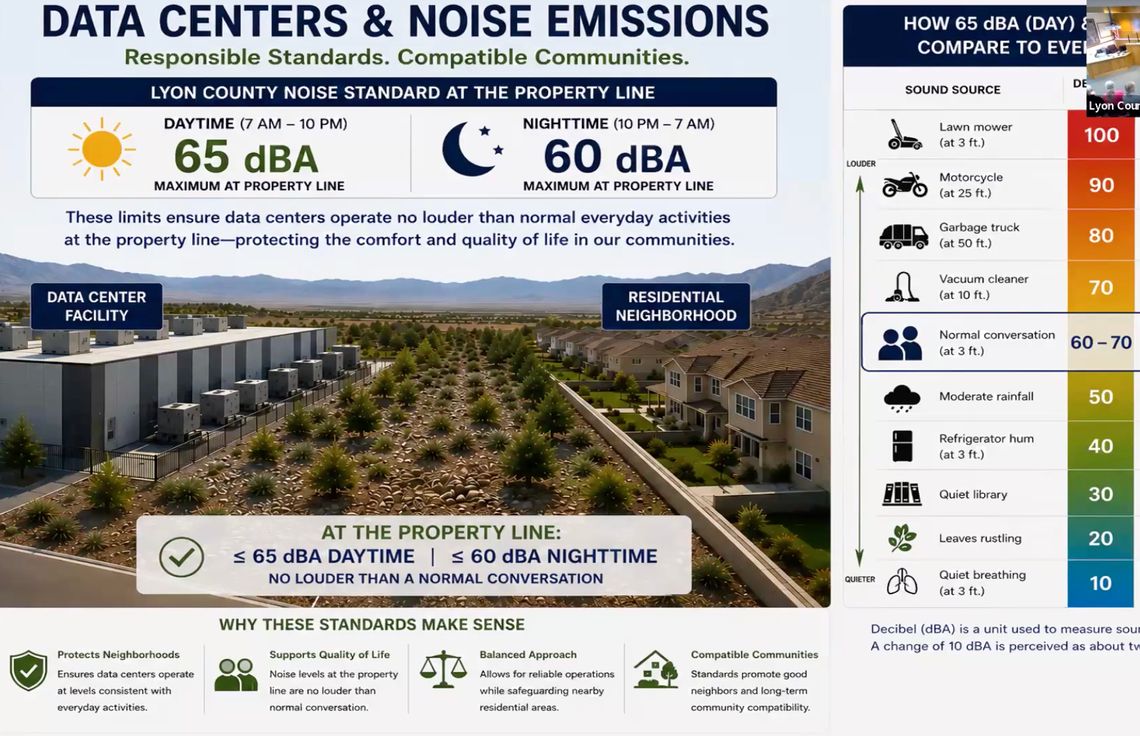
The draft’s noise limits are 65 decibels during daytime hours and 60 decibels at night, measured at the property line. The standards mirror existing Lyon County industrial noise limits.
Developers would be required to provide a noise study before approval and complete a second test before receiving a certificate of occupancy. Mechanical vents and exhaust systems would also be directed vertically to reduce lateral transmission of noise.
Residents said those standards do not adequately account for continuous low-frequency sound, vibration or the quiet background conditions common in rural areas.
Commissioners asked staff to consider whether noise, setbacks and other requirements should increase with the size or height of a facility.
The proposed ordinance also regulates battery energy storage systems, emergency generators and natural gas power plants serving data centers.
Battery systems would be required to comply with national fire, building and electrical standards and receive approval of a management plan addressing fire prevention, thermal runaway, ventilation, spills and emergency response.
Natural gas generation could be treated as an accessory use if it is located on the data center campus, primarily serves the data center and does not exceed 125% of the facility’s maximum electrical demand. Larger or commercially operated power plants would require separate approval.
Emergency generators would be required to meet the highest federal emissions tier identified in the draft, and routine testing would be limited to between 7 a.m. and 7 p.m.
Commissioners asked staff to strengthen the language addressing generator emissions and determine whether the ordinance should require additional pollution controls or equivalent technologies.
The ordinance also requires developers to submit a decommissioning plan and provide financial security equal to 150% of the estimated cost of removing battery systems, natural gas generation, solar equipment and other specialized infrastructure.
Commissioners questioned what would happen if a data center reduced operations but did not close entirely, if the building were converted to another use or if contamination were discovered after the county released the financial security.
Staff said those issues are not fully addressed in the current draft and could be considered in the revised version.
Public testimony was sharply divided.
Many residents called for a one-year moratorium on data center approvals and urged commissioners to delay consideration of the Monarch project until the ordinance is completed.
Others supported data center development but said the county should impose strong, measurable and enforceable standards.
Representatives of the Nevada Data Center Alliance, Comstock Inc., electrical workers and other business interests cautioned against regulating data centers more strictly than other industrial uses unless the differences are tied to measurable impacts.
Several industry speakers also warned that technology is changing quickly and encouraged the county to regulate outcomes such as water consumption, noise and emissions rather than requiring or prohibiting specific technologies.
A recurring concern throughout the meeting was whether the proposed Monarch project would be subject to the new ordinance.
Residents argued that the project has not received final approval and should be required to comply with the same standards as future data centers. Others said applications already submitted may be reviewed under the rules in effect at the time of filing.
The board did not clearly resolve that question during the workshop.
Staff will now incorporate the board’s direction and public comments into another version of the ordinance, which will return through the county’s formal ordinance process with additional opportunities for public review.




Comment
Comments