

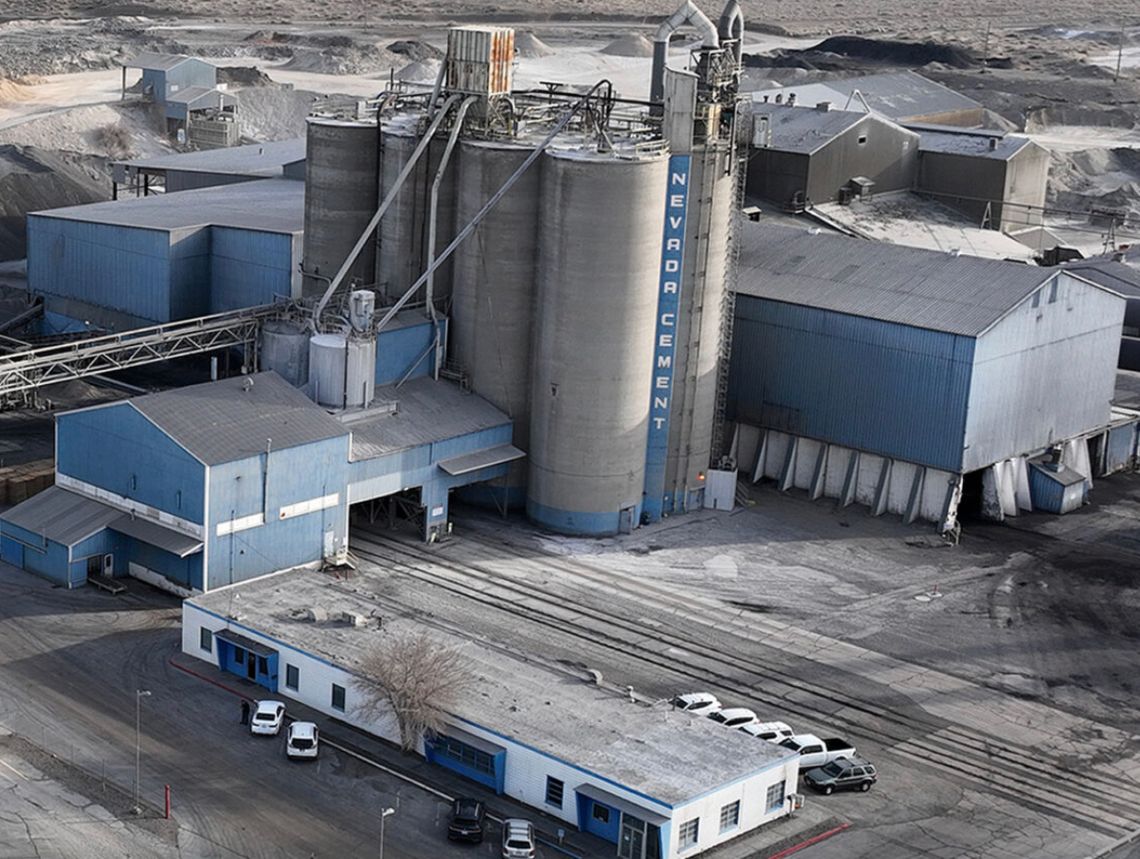
Most people have driven past Nevada Cement’s plant west of Fernley without giving much thought to what happens behind its silos, conveyors and towering kilns.
Yet much of Northern Nevada’s growth begins with the powder made there.
Cement from the plant is used in concrete for roads, bridges, industrial buildings, homes and mining operations across Nevada and the surrounding region. The facility employs approximately 120 people and supports truck drivers, mechanics, contractors, equipment suppliers and other businesses needed to keep a major industrial plant operating around the clock.
Jared Kupcak, Nevada Cement's project manager, recently spoke to members of a local Rotary club, said one of the first things people misunderstand is the difference between cement and concrete.
Nevada Cement does not manufacture the sidewalks, bridge decks or foundations residents see across the region. It produces the fine powder that binds those structures together.
“We just make the glue powder,” he said.
Cement is an ingredient in concrete, much as flour is an ingredient in a cookie. Ready-mix companies combine cement with water, sand, rock and other additives to create concrete designed for a particular use.
A residential sidewalk may require a different mixture than a bridge, highway or industrial foundation. The cement is the binding ingredient that allows the mixture to harden into an artificial stone capable of carrying enormous loads and enduring years of traffic and weather.
The Nevada Cement plant began operating in 1964 and is now a subsidiary of Dallas-based Eagle Materials.
The plant was originally part of Centex Materials, a name longtime Fernley residents may remember. More than six decades later, the facility remains an established part of the local economy, but it is also an aging industrial plant facing questions about its future.
The plant operates 24 hours a day for most of the year. Shutting it down is neither quick nor inexpensive. Its enormous kilns can take about a day to reach operating temperature and another day to cool.
“It doesn’t close for Christmas,” Kupcak said.
Planned shutdowns generally occur only for major maintenance.
The operation includes employees who handle incoming materials, monitor production, maintain mechanical and electrical systems, manage quality control, oversee safety and environmental compliance and handle sales, finance and administration.
Approximately seven employees work each operating shift, while maintenance, electrical, management and support employees generally work during the day.
The work can be hot, dusty, noisy and physically demanding. Employees work around extreme temperatures, heavy equipment and powerful mechanical systems. Kupcak said safety is discussed daily, with the company reviewing injuries, unusual work and incidents to determine how they can be prevented.
“You can’t have a good plant if people are getting hurt all the time,” he said.
Cement production begins with limestone, which supplies roughly 80% of the raw material used in the process.
Nevada Cement historically mined limestone from hills south of the plant. As that source has been depleted, the company has increasingly relied on other Nevada deposits, including mining areas near Interstate 80 and U.S. Highway 95 and in the Relief Canyon area near Lovelock.
Limestone alone is not enough. The plant must carefully combine sources of calcium, silica, alumina and iron while limiting unwanted concentrations of magnesium, sulfur and alkalis.
Clay comes from the Flanagan area north of the Pyramid Lake Paiute Reservation. Silica-bearing material is mined south of Fernley, and gypsum used near the end of production comes from the Empire area. Kupcak said nearly all of the plant’s raw materials, with the exception of iron, come from Nevada.
The raw material is crushed into pieces smaller than an inch and placed in a ball mill, a large rotating cylinder filled with steel balls. As the cylinder turns, the balls tumble and grind the material into an extremely fine powder.
That powder enters one of the plant’s rotary kilns. Each kiln is approximately 400 feet long and 11 feet in diameter. It rotates on a slight incline, slowly moving the material toward a flame at the lower end.
Gas temperatures in the burning zone reach approximately 3,000 degrees Fahrenheit, while the material itself is heated to about 2,500 degrees.
At that temperature, the ingredients undergo chemical changes and form a new mineral product called clinker. The dark, rocklike clinker is cooled and ground again with gypsum, limestone and other materials to create finished cement powder.
From beginning to end, the process is a careful balance of chemistry, temperature, timing and grinding.
“You have to get the right components just right, grind them just right and then burn them just right,” Kupcak said.
Nevada Cement supplies ready-mix producers serving construction projects throughout the region. Gold mines also use cement to produce concrete and shotcrete, a spray-applied material used to stabilize underground mine surfaces and other excavated areas.
Cement from the Fernley-area plant was used in major regional infrastructure, including portions of Interstate 580 and the Galena Creek Bridge between Reno and Carson City, Kupcak said.
Concrete pavement generally costs more initially than asphalt but can last longer under heavy traffic. That durability can be important on interstate highways, freight routes and mountain passes where lane closures and repeated resurfacing create additional economic costs.
Kupcak cautioned, however, that failed pavement is not necessarily the fault of the cement or concrete. Road performance also depends on engineering, drainage, compaction, reinforcement, aggregate quality, joint placement and construction practices.
“It’s a whole bucket full of variables that can make the concrete fail,” he said.
The plant’s economic impact extends beyond its approximately 120 direct employees.
A cement operation relies on trucking, mining, welding, electrical work, heavy-equipment repair, construction, engineering, environmental consulting and specialized maintenance.
“We spend a fortune on maintenance,” Kupcak said.
The plant also buys fuel, electricity and services, while its employees earn and spend wages in surrounding communities.
Its location gives Fernley residents an opportunity to hold industrial, mechanical and technical jobs close to home rather than commuting to Reno, Sparks or the Tahoe Reno Industrial Center.
That local-workforce connection is increasingly important as Interstate 80 traffic worsens and employers compete for workers.
Kupcak said the plant needs to hire at least six additional employees, but recruiting can be difficult. Industrial work requires people able to manage physical demands, irregular hours, heat and complex equipment. The plant also competes with warehouses and other facilities offering climate-controlled working conditions.
At the same time, experienced industrial workers are approaching retirement, threatening to leave a skills gap in manufacturing, mining and the trades.
Kupcak said employees with farming backgrounds often adapt well because they are accustomed to hard work, equipment, changing conditions and practical problem-solving.
Cement is essential to modern construction, but producing it requires significant energy and creates substantial carbon dioxide emissions.
The plant burns fuel to generate the high temperatures required in the kiln. The chemical conversion of limestone also releases carbon dioxide during production, meaning even replacing fossil fuels would not eliminate all emissions.
Nevada Cement primarily uses coal, with some natural gas and petroleum coke, Kupcak said.
Cement kilns can also use alternative fuels, including wood waste, tires, railroad ties and fuel derived from material that might otherwise enter a landfill.
The company must also control pollutants including nitrogen oxides, sulfur compounds and mercury. The plant uses ammonia injection, hydrated lime and activated carbon, and its emissions are subject to state and federal monitoring. Nevada Cement holds a Class I air-quality permit through the Nevada Division of Environmental Protection.
Kupcak acknowledged that the plant’s early history did not reflect modern environmental expectations. Newspaper accounts from the 1960s and 1970s described dust and limited pollution controls that he called embarrassing by today’s standards.
The plant now operates under significantly more extensive collection, monitoring and reporting requirements.
The largest question is what comes next.
The facility was built when industrial plants were designed with far less attention to energy efficiency. Its older equipment requires large amounts of electricity and fuel.
The plant can consume roughly 12 megawatts of electricity, Kupcak said, an industrial load he compared with a significant portion of Fernley’s overall demand.
Eagle Materials is modernizing its Mountain Cement operation in Laramie, Wyoming. That project will give the company information about the cost, permitting, construction and operation of a modern cement facility.
Nevada Cement could eventually be considered for a similar investment, although no Fernley project has been formally announced.
A replacement facility could cost more than $400 million. Modern equipment could substantially reduce fuel, electricity and water consumption while improving reliability, production capacity and emissions performance.
“We really need to look at modernizing,” Kupcak said. “At some point, something needs to happen here.”
The alternative is greater reliance on imported cement.
Northern California already depends heavily on cement arriving through ports, much of it manufactured overseas. Eagle Materials operates an import terminal in Stockton and brings some imported material by rail to help meet demand the Fernley plant cannot supply on its own.
Imported cement can be manufactured overseas, placed on ships and transported across the Pacific at a cost low enough to compete with domestic production.
But it does not create the same Nevada jobs, local purchases or supply-chain activity as a plant operating here.
Nevada Cement’s case for modernization is therefore larger than preserving one industrial site. It is about whether the material needed to build the region’s roads, bridges, mines, homes and businesses will continue to be produced by Nevada workers using largely Nevada-sourced materials.
“We would rather it be a facility that uses Nevada materials and Nevada people,” Kupcak said. “We’re trying to do something that maintains the local economy.”
Every bridge, warehouse, highway and foundation begins with raw materials most people rarely consider.
In Fernley, much of that work begins behind the Nevada Cement sign, where Nevada rock is crushed, ground, heated and transformed into the powder that holds a growing region together.





Comment
Comments