

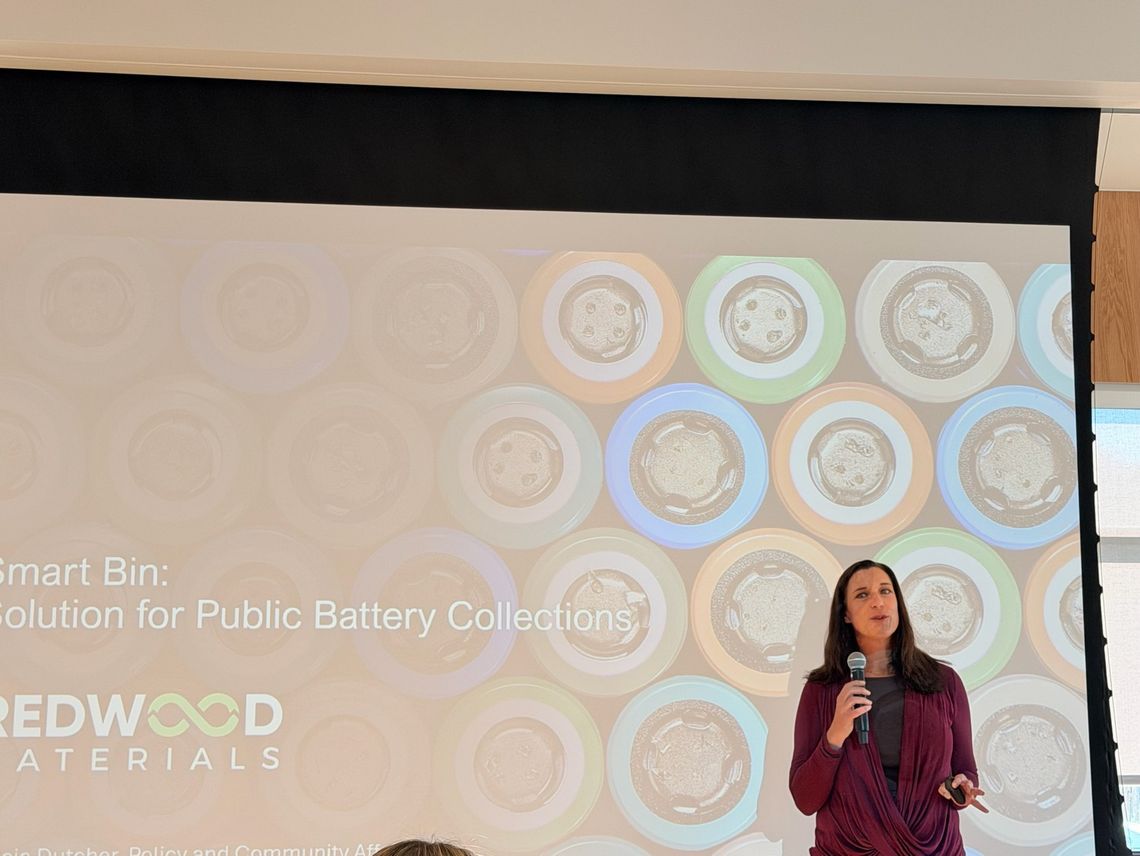
Redwood Materials is testing a new public battery collection system in Fernley as part of an effort to make lithium-ion battery recycling safer and more convenient.
Tricia Dutcher, who works in policy and community affairs for Redwood Materials, presented the company’s new “smart bin” program during a Fernley Chamber of Commerce meeting last week. The bin is designed to accept rechargeable batteries and battery-powered devices without requiring customers to sort, tape or individually package them.
Redwood Materials operates a large battery recycling and materials manufacturing campus in Storey County. Dutcher said the company recycles old batteries to recover lithium, nickel, cobalt, copper and other materials that can be used to produce components for new batteries.
“We call ourselves a battery recycler, but actually what we do is produce the material that goes into batteries,” Dutcher said.
The company’s goals, she said, are to increase the domestic supply of battery materials, reduce battery costs and lessen the environmental effects associated with producing new materials.
According to Dutcher’s presentation, Redwood recycles approximately 20 gigawatt-hours of lithium-ion batteries each year, equivalent to about 40,000 metric tons of material or batteries from approximately 250,000 electric vehicles.
She said Redwood currently handles about 75% of the lithium-ion batteries recycled in the United States, although batteries collected throughout the country may eventually be transported to the Nevada facility.
The company also recovers materials from consumer products, including cellphones, laptops, cordless tools, rechargeable household devices and other products containing lithium-ion batteries.
Those smaller household batteries are among the most difficult materials to collect, Dutcher said, because recycling depends heavily on individual consumers knowing which devices contain batteries and where to take them.
An average household may contain approximately 50 rechargeable batteries, she said. They can be found in phones, computers, earbuds, toys, cordless vacuums, power tools, electric toothbrushes, speakers, drones and many other products.
The problem arises when those devices stop working and are placed in household garbage or curbside recycling.
Lithium-ion batteries can be damaged when compacted in garbage trucks, recycling equipment or landfills, creating the potential for fires. Dutcher said those fires can endanger sanitation workers, equipment operators and others working in the waste and recycling system.
“You can’t put it in your curbside garbage,” she said. “It’s going to get crushed in the truck, and that causes truck fires.”
Putting batteries in a curbside recycling container is also unsafe because most traditional recycling facilities are not equipped to process them, she said.
Although some retailers offer battery recycling, Dutcher said the collection containers can be difficult to locate, may accept only certain battery types and often require customers to prepare batteries before depositing them.
Redwood’s smart bin was created to address those limitations.
The approximately 5½-foot-tall unit contains a steel collection drum, sensors, remote monitoring equipment and material designed to isolate batteries from one another. As batteries are deposited, the system layers them with a granular fire-suppression material.
If one battery begins to overheat, the material is intended to absorb heat and prevent the problem from spreading to neighboring batteries.
The system also monitors the temperature and volume of the material inside the bin. When the collection drum is full, Redwood receives an electronic notification and sends a contractor to replace it.
The bin remains locked except when a user activates the deposit door. Dutcher said the system will remain locked if sensors detect a potential problem.
The collection drum and fire-suppression material received a special permit from the U.S. Department of Transportation, she said, allowing full drums to be transported without employees sorting or individually taping each battery.
That is important because federal shipping requirements can make public battery collection difficult and expensive.
The bin was also designed so that businesses or public facilities hosting one do not need specialized equipment or extensive employee training.
“It needs to accept everything safely without requiring any prep,” Dutcher said. “It can’t require specialized training or take a significant amount of a host site employee’s time.”
Redwood developed the smart bin as a prototype and is testing it through a grant-supported pilot program. Dutcher said one bin has been placed in Fernley, with additional units operating in Washoe County and Carson City. More are expected to be installed in area libraries.
The company is also testing bins in other locations, including New York City, where residents of high-rise apartment buildings may have limited access to battery drop-off locations.
Dutcher said the goal is to study how the bins perform in different communities and determine whether the system can be expanded.
“We’re hoping that we keep pointing to Nevada as the site of innovation for these lithium batteries,” she said.
The bins accept rechargeable lithium-ion batteries, rechargeable nickel-metal hydride batteries and many battery-powered devices. Small devices such as phones or earbuds may be deposited whole if the battery cannot easily be removed.
Larger products should be separated from their batteries when practical. Lead-acid automobile batteries are not accepted and should instead be returned to an auto parts store or another approved collection site.
Dutcher said Redwood’s larger mission is to create a domestic, closed-loop battery supply chain in which valuable materials are recovered, refined and reused rather than discarded.
She said the company also recovers aluminum, copper, steel and other materials from battery packs, along with much of the packaging used to transport them.
“Metal is infinitely recyclable,” Dutcher said. “If it was used in a battery, somebody out there is using it in something else.”





Comment
Comments