
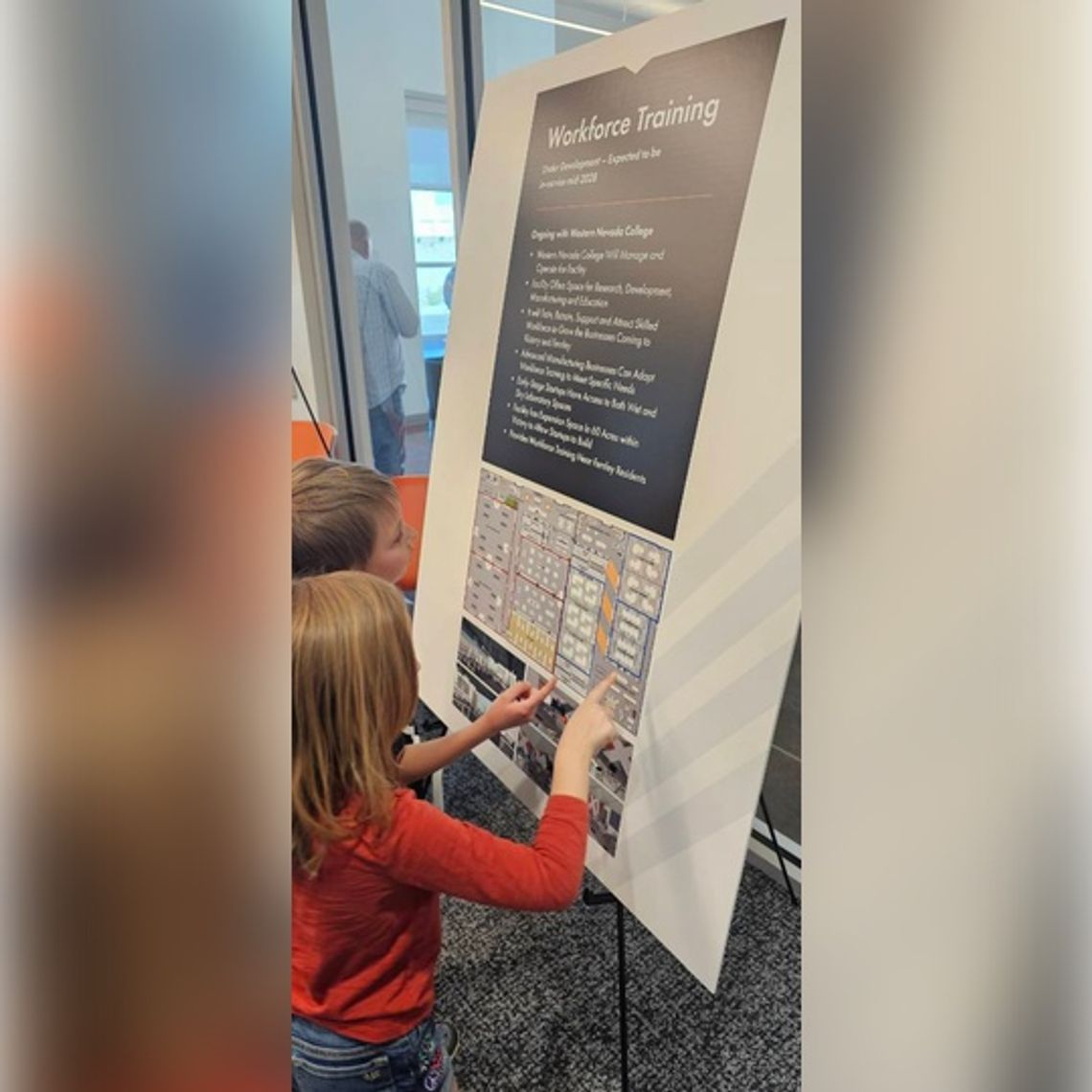
Mark IV Capital drew more than 200 people to its first public open house last Saturday at the Victory Logistics District, giving residents a detailed look at the rail, power, road and workforce-development projects now taking shape. Mark IV Vice President Rick Nelson said the turnout exceeded his expectations and confirmed what the company has been hearing for months: many residents simply don’t know what’s happening behind the fences.
“People drive by and think nothing is going on,” Nelson said. “Now they realize there’s a lot going on.”
He said the open house was the first in a planned series of public events designed to offer tours, answer questions and gather community input. Attendees were encouraged to leave written comments, and Nelson said Mark IV will compile those comments and deliver them to the City of Fernley as it prepares its North Fernley Master Plan.
Nelson said most visitors were surprised not only by the amount of work already completed but by the scale of what is coming next. The rail spur, he said, is now 60 percent complete, with ballast in place and crews welding track. The line is expected to be operational by September, a milestone he called critical for attracting advanced manufacturing. Two companies are evaluating sites because rail-served property is scarce in northern Nevada.
He also highlighted progress on the proposed Fernley Power District, which he said is nearing 90 percent design completion. Mark IV is working with the city to finalize the structure, and Nelson emphasized that the district would operate outside NV Energy’s service area.
“It doesn’t touch any of the ratepayers,” he said. “It’s insulated.”
Nelson said the district would operate under a city-approved franchise, generating franchise-fee revenue for Fernley. Nelson said the model creates a self-contained economic engine where franchise fees boost the city budget, new businesses expand the tax base, workforce demand grows, and property and sales taxes increase.
“We built a mechanism that benefits the city without costing the citizens,” he said.
Nelson said the two concerns he hears most often from residents are that data centers use too much water and that the project will strain the region’s power supply or raise electric bills. He said both concerns are based on outdated assumptions.
“Microsoft has already applied to the city for their campus at just over nine acre-feet per year,” Nelson said. “That’s less than seven houses. The City of Fernley has given out permits for new housing over 100. When you compare that to what we’re building, we’re vastly underneath it.”
On power, he reiterated that the Victory project’s power district is separate from NV Energy and therefore has no impact on local rates. Instead, he said, it creates a new revenue stream for the city from a franchise fee and makes the district more attractive to advanced manufacturers. Workforce development is also beginning to take shape. Western Nevada College President J. Kyle Dalpe attended the open house, and Nelson said several companies are working with WNC to train electricians, welders, HVAC technicians and, eventually, more specialized trades.
“Workforce development provides job opportunities ad infinitum,” he said.
Residents were able to view maps showing future road alignments, the Nevada Pacific Parkway connection and the broader North Fernley development plan. Nelson said future open houses will continue to show where roads will go and how infrastructure ties together.
“Most people are pleasantly surprised at the progress,” he said. “They’re very surprised at the amount of future progress that’s in place, and they’re extremely happy that there’s some level of revenue generation that can go to the city.”
Nelson said many components of the project are on schedule and on budget, but progress cannot move faster than the pace of required reviews and approvals.
“Can we go faster?” Nelson asked. “I don’t think so. We have to go at the speed of review and approval.”
He said Mark IV is navigating approvals from the city, state agencies, federal agencies, Union Pacific, NDOT and other regulatory bodies.
“Everyone gets to put their fingerprints on everything,” he said. “Every review and every comment has to be reconciled. All of that consumes time and effort. But we’re moving through it.”


Comment
Comments