

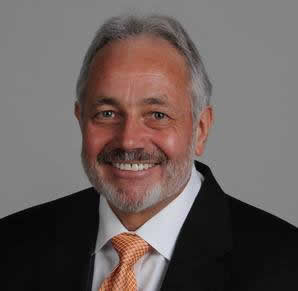
Nevada's 4th U.S. House District Rep. Steve Horsford, D-Las Vegas, is not a big fan of taking water from one part of his congressional district -- White Pine County -- and moving it to another area -- the Las Vegas valley.
"What I have really been trying to focus on are alternatives to producing more water options so that this is not the only option on the table," Horsford said Wednesday on Nevada Newsmakers about the proposed White Pine water grab.
Instead, Horsford is advocating water desalination in California. That, in turn, could be a solution to Southern Nevada's water problems.
"There is real opportunity around water desalinization that would help parts of California tremendously and that would allow us to renegotiate allocations of water from the Colorado River in order for Nevada to get more of our share," Horsford told host Sam Shad.
"So those things are realistic," Horsford said about California desalination plants. "There is a lot of new research and technology."
Water desalination in California, although it has detractors, is moving forward on multiple fronts, according to news reports.
Recently, bond ratings for the Carlsbad Desalination Plant and pipeline were upgraded and given a stable outlook, affirming the project’s ability to provide a stable, reliable source of drinking water to the San Diego region.
Also, Southern California desalination plants proposed for Huntington Beach and Dana Point got big boosts this month when the federal EPA selected them to apply for huge low-interest loans that would increase the viability of the projects.
"Obviously, this is a long-term priority that we need to address," Horsford said of desalination. "But that has been my focus at the federal level -- to broaden the discussion, identify more opportunities and resources so we are not just focused on taking water from one part of Nevada for the needs of another part. That alone is not a future that is going to sustain us for the long term."
Desalination is an issue for many congressional representatives from the Western U.S., he said.
Some, including Horsford, took a recent trip to Israel to view that nation's extensive desalination efforts. Israel gets 55 percent of its domestic water supply from desalinated seawater and brackish groundwater, according to ISI Water, an international water treatment company.
"This is not just an issue that is a priority for Nevada," Horsford said. "I have talked to my colleagues from California. Actually, I was on a trip to Israel with my colleagues, Democrats and Republicans, and visited a desalination plant there. The same plant they have in Israel, they are looking to develop in two locations in California as we speak."
Horsford did not mention the two specific plants although much attention has recently been given to the proposed sites at Huntington Beach and Dana Point.
"Based on those two projects, that would automatically change the equation that we have historically had," Horsford said.
When pressed by Shad if he was talking about a 20-to-30 year project, Horsford was evasive, finally saying, "It is not going to happen overnight, I'll give you that."
Desalination is still in the developmental stages, Horsford said.
"These are initial conversations," he said. "First, we have got to show the new development, the new technology around desal (desalination) really does work and would address the water needs of the central part of California and in certain urban areas in Southern California. I think that is phase one."
Horsford wants to see negotiations begin about increasing Southern Nevada's share of Colorado River water with the onset of desalination in California.
"Obviously, Pat Mulroy (former head of the Southern Nevada Water Authority) and other people who have a lot more expertise than I do have the history and have fought this fight for a very long time," Horsford said. "But I am looking into the future of what we need to do to make sure that we are positioned -- not just Nevada but the entire Intermountain West -- and looking at our water needs from a regional perspective and not just with the growth demands in one part of our state alone."
Horsford's push toward desalination is similar to one recently proposed by Mulroy.
Mulroy told the Las Vegas Review Journal's Henry Brean that a pipeline could be built through Mexico to deliver ocean water to the drying-up Salton Sea. Some of the water could be used to stabilize that inland sea. Some could be pushed through a desalination plant and used to irrigate Imperial Valley crops that now rely on Colorado River water.
That could free up Colorado River water for Nevada, to augment its small 300,000-acre-foot share it now receives.
The predicted rise in population in Las Vegas and the surrounding area could increase the viability of desalination, John Entsminger, general manager of SNWA, told Nevada Newsmakers last year. Entsminger predicted the Southern Nevada population could grow to 3.6 million within 50 years, really pushing the technological research into desalination.
"If I got my my crystal ball out, I believe that in 30, 40 years from now, Southern Nevada probably will have an equity interest in a desalination facility either on the coast of California or on the Pacific coast of Mexico," Entsminger said in March of 2018. "We've put in place a lot of legal agreements between the United States and Mexico to meet those types of exchanges possible."
Watch this episode of Nevada Newsmakers.
See the upcoming schedule of Nevada Newsmakers.





Comment
Comments