

By Daniel Rothberg
https://thenevadaindependent.com
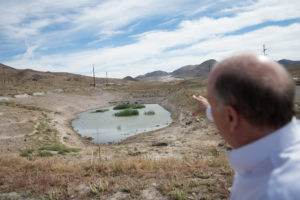
Under a breezy blue sky in the Tahoe-Reno Industrial Center on Wednesday, water streamed out of a tan industrial hose and filled a small sink in the middle of the high desert. The water is there for free-roaming horses, says Kris Thompson, the property manager at the massive industrial center, known as TRIC. But no horses were there Wednesday morning. Apart from a few birds skimming off the pond, only a congregation of black cattle was visible at the man-made watering hole.
At TRIC, Thompson says cows and horses share the range and the water.
“There’s not much competition,” said Thompson, who grew up on a ranch in Kansas and noted that there are only a small number of cattle, about 250, that graze within the TRIC property.
That’s not the case in much of Nevada, where wild horse advocates argue with ranchers over what is best for the range. Horses, land managers say, often compete for resources, frustrating ranchers and some conservationists who argue they overpopulate the range, taking out water, food and habitat for cattle and imperiled native species. Wild horse advocates argue that the effects of ranching on public land are instead a main driver of range degradation.
Most wild horses are managed by the Bureau of Land Management (BLM), under a federal law passed in 1971 that required the agency to protect horses as symbols of the West. But in some rare instances, states — not the BLM — have jurisdiction over free-roaming horses. Such is the case at TRIC, part of the Virginia Range, which starts east of Reno and extends into Virginia City.
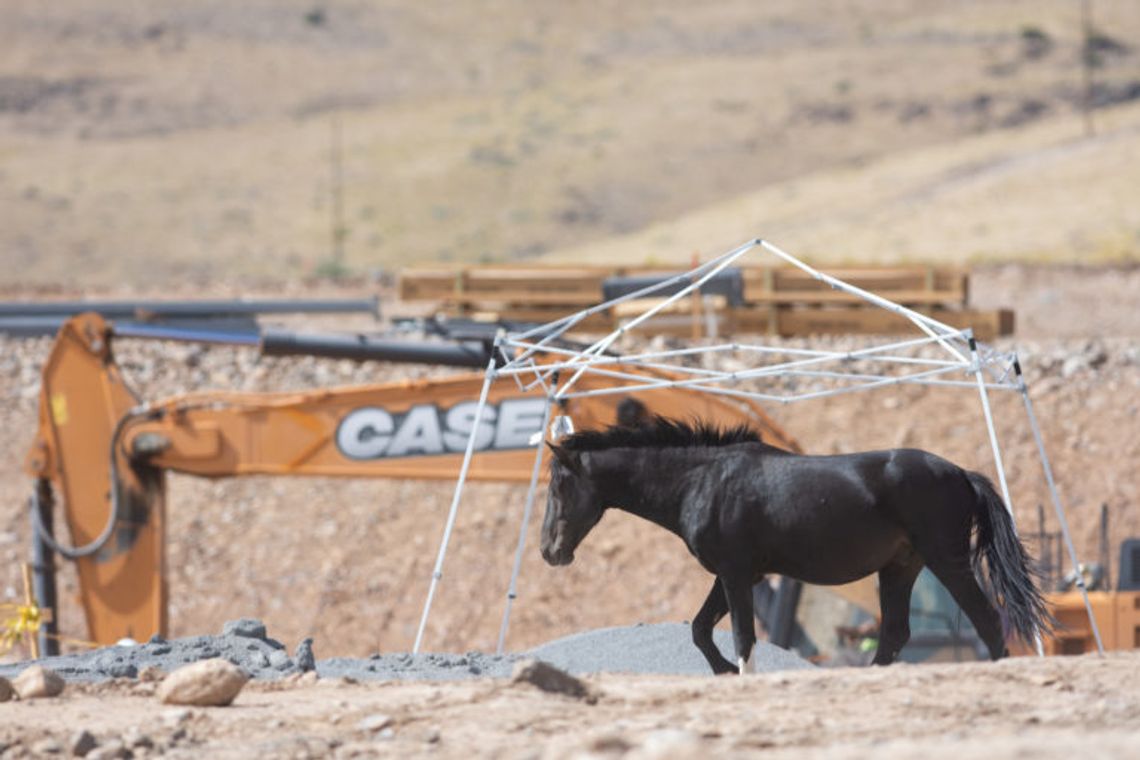
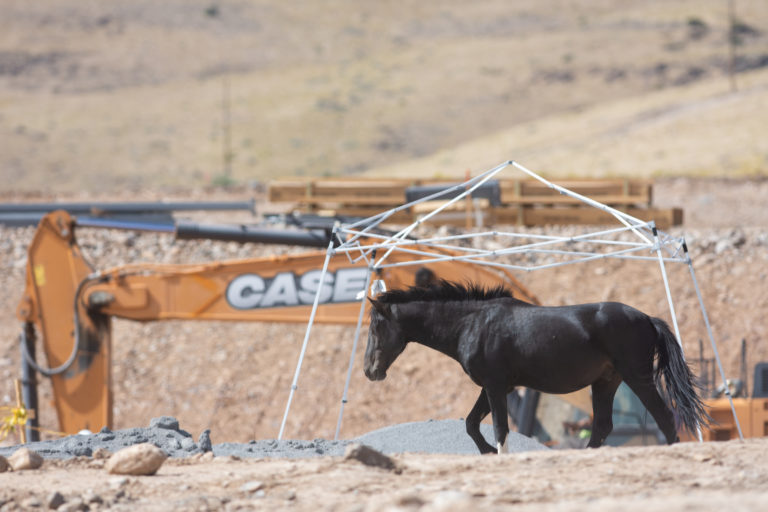
Herds of horses, owned by the state, are free to roam into developments and backyards. They trot along private property near the Tesla Gigafactory, near the Walmart Distribution Center and near large empty lots where big household-name companies like Google have scooped up land.
But in recent years, these Virginia Range horses have faced several challenges — from development to a political effort to reduce their herds. And at TRIC, development has clashed with one of the oldest and pressing issues for horses in Nevada: water.
Getting horses to water safely at the industrial park can be difficult, a problem that is at its worst in the summer months. With more roads and development at the park, especially after Tesla chose to build a 1.9 million square-foot battery factory there, it has been more difficult for horses to get to traditional water sources like the Truckee River, which runs along the side of the industrial center.
The businesses at TRIC, in the past few months, have been working on a fix. The industrial center’s General Improvement District (GID) has set aside water rights to ensure the horses have enough to drink. Businesses such as Switch and Blockchains, LLC, a company that quietly purchased more than 67,000 acres of land at the park, have also started participating in the program.
The goal is to create a ring of watering holes, like the one Thompson stood at Wednesday morning, that will keep horses away from roads — horses often wander onto the highway — and hydrated through the summer months. The industrial center also wants to divert horses away from a holding pond for reclaimed water, a source of water currently used by several herds.
“Everyone asks: ‘Why are we doing this?’” Thompson said. “Because my boss Lance Gilman and my other boss Don Roger Norman — these horses are important to them. This is their symbol of Nevada, their symbol of the West.”
There are other advantages too.
On tours, companies considering a move to the industrial park are often awed by the sight of wild horses and see their preservation as aligning with corporate environmental goals.
Thompson did not say how much water has been devoted to horses, but it’s a small amount when compared to the roughly 300 million gallons of water used annually at the industrial park. And the companies, he said, are pursuing their own projects using their own water budgets.
After a spring went dry, Blockchains allowed the American Wild Horse Campaign onto its land to provide the horses supplemental water, according to a promotional video created by the group. The company, which is pursuing blockchain-related technology but has given few details about its business, said it also made a donation to the organization for a long-term solar well pump.
“We’re just generally pleased that the properties and the [park] management have been so pro-protecting wild horses,” said Suzanne Roy, executive director of the organization.
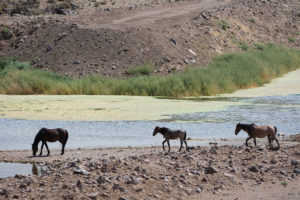
In Nevada and across the West, drought is a huge threat to free-roaming horses. Already this summer, the BLM has had to conduct several emergency roundups in Nevada. In Arizona and Colorado, water has been hauled in by the truckload, the Associated Press reported.
Horse advocates often object to the roundups because they think land managers use drought as an excuse to take wild horses off the range, a practice that is the subject of a fierce debate. Shoring up water to prevent horses from being taken off the range is a win-win, they said.
Even though the horses roam on private property, they are the responsibility of the Department of Agriculture, an ownership responsibility that, in recent months, the agency has looked to discharge itself of. In December, the board that governs the Department of Agriculture voted to solicit bids from nonprofit organizations that would be willing to take over ownership of the Virginia Range horses. Since then, no nonprofit group has wanted to assume the liability for the health and safety of the horses.
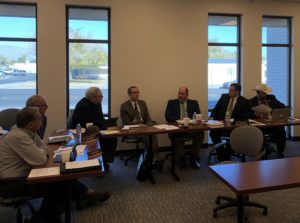
The move from the board came after the department terminated a cooperative agreement with the American Wild Horse Campaign in October. By the time the agreement was ended, the two organizations were sparring over what to do with about 3,000 horses on that range. They were publicly accusing each other of spreading misinformation in op-eds and in press releases.
During nearly two hours of public comment in December, advocates said that the decision could lead to the horses being sold off, where they could end up in an international slaughterhouse (horses cannot be slaughtered in the U.S.). One person went as far as to call the proposed ownership change a “death warrant.” Jim Barbee, the director of the department at the time, said that the intent was to find a “reputable” nonprofit organization that had more resources to manage the horses — the agency does not traditionally engage in wildlife management.
Gov. Brian Sandoval, who has been criticized by horse advocates, also put out a statement in December, that said he was “supportive of the Department of Agriculture working alongside any organization that will humanely help manage or adopt the Virginia Range horse population.”
Thompson and Gilman, as representatives of TRIC, wrote multiple letters to the board, urging them to not transfer ownership of the horses and to work out a new management contract.
“I wish the state could do more,” Thompson said on Wednesday. “Clearly, as you saw from our letters, Lance [Gilman] feels strongly that the horses need to stay under state management.”
Today the department still controls the wild horses.
Doug Farris, the animal industry division administrator for the department, said in a statement that the agency is working with wild horse advocacy groups, including Virginia Range Sanctuary and Wild Horse Connection, to help the state monitor the horses for safety and provide them water and food But it remains up to the department’s board to determine their long-term future.
Thompson said he would like to see the cooperative agreement reinstated, at least until there is a new governor in place and potentially a change to the composition of the department’s board.
That agreement would allow the wild horse campaign to begin darting the Virginia Range horses with birth control to keep the population in check.
“This agreement is a win-win for everybody and there would seem to be a way to work this out,” he said.
Disclosure: Switch and Lance Gilman have donated to The Nevada Independent. You can view a full list of donors here.


Comment
Comments