

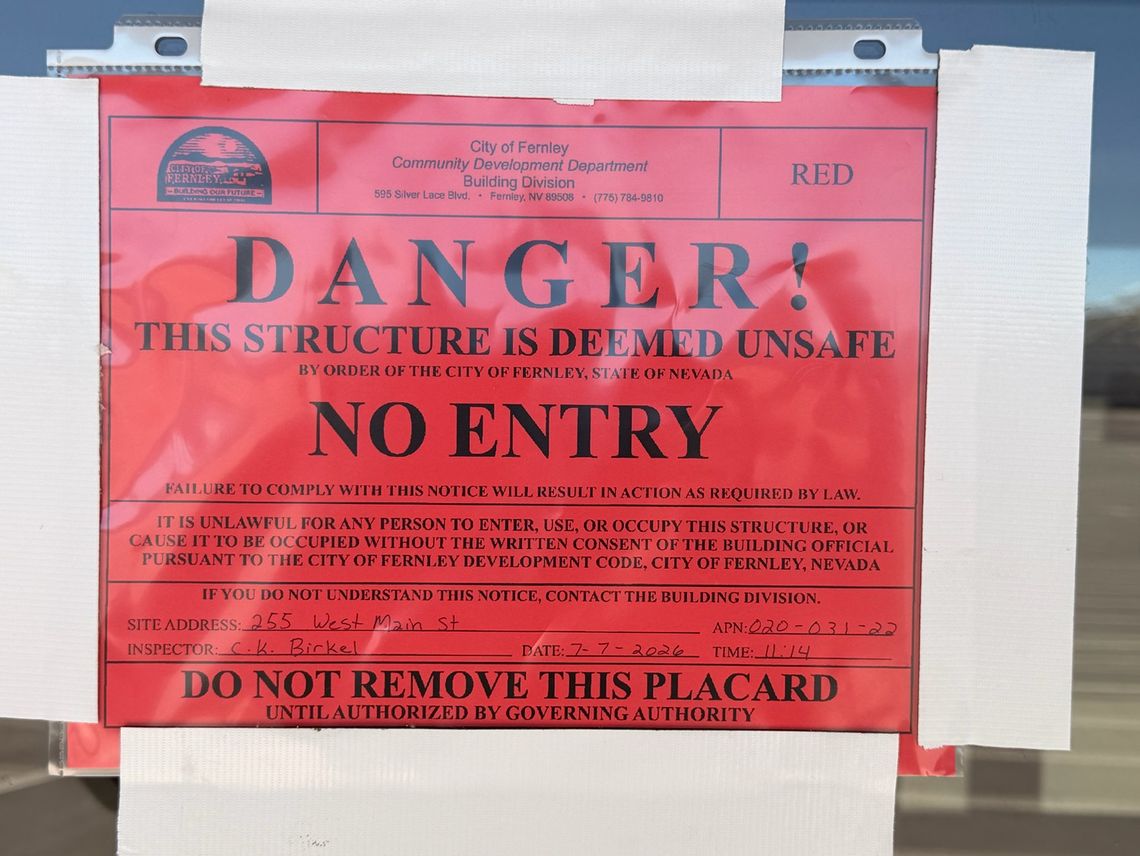
The recent temporary closures of two prominent Fernley businesses have brought renewed attention to the city’s growing code-enforcement workload and an ongoing effort to rewrite its enforcement rules.
The Wigwam restaurant was closed after a portion of its ceiling collapsed because of water damage, according to Fernley Building Official Charity Birkel.
Birkel said the Nevada State Health Department made the initial decision to close the restaurant. The city then closed the entire establishment to prevent employees or customers from entering the kitchen beneath the damaged ceiling.
“The ceiling had some significant water damage, and it was a safety issue having people walk under it,” Birkel said in an email to the Fernley Reporter.
A contractor quickly obtained a building permit, completed the repairs and received approval from the city to remove the red tags, she said.
McDonald’s was also temporarily closed by the Nevada State Health Department. Birkel said the restaurant responded immediately and was apparently reopened within about four hours, although she referred questions about the exact timeline to state health officials.
Neither closure was initially ordered through Fernley’s regular complaint-based code-enforcement process. Still, the highly visible incidents come as the city reports a sharp increase in complaints and continues debating how broadly its enforcement authority should reach.
During a July 8 presentation to the Fernley Builders Association, Birkel said the city received 132 code-enforcement complaints in June alone.
Since January, Fernley has logged 618 cases. Birkel said the city previously received approximately 660 complaints during an entire 12-month period.
That means the city has already received nearly a typical year’s worth of complaints during the first half of 2026.
Birkel said one resident filed approximately 27 complaints involving properties with similar alleged violations after the city acted on a separate complaint.
The volume raises questions about whether the rise reflects worsening property conditions, increased public awareness or a system that can be driven by repeated complaints from a small number of residents.
City officials have also held four public workshops on a proposed rewrite of Fernley’s code-enforcement rules. The proposal reportedly runs 47 pages and has drawn significant opposition from residents concerned about property rights, enforcement discretion and the potential reach of the new rules.
Birkel told builders the city has also received support for the proposal, although some supporters have been reluctant to speak publicly.
“Unfortunately, because of the mob mentality with the negative comments, people are afraid to speak up,” Birkel said.
The remark highlighted the increasingly tense debate over the proposed ordinance. Critics have questioned whether the city is attempting to regulate too much private-property activity, while city officials have argued that clearer rules are needed to address unsafe and neglected properties consistently.
Birkel said she had been directed to review the proposal and remove provisions already covered elsewhere in city code. A revised version is expected to return for additional public discussion.
The building department’s workload extends beyond complaint investigations. In June, the city received 51 building applications and issued 45 permits, collecting approximately $49,000 in fees.
The department also completed 628 inspections, including six business-license inspections, and reported no disaster-assessment callouts during the month.
Those numbers show a department handling both routine development activity and a rapidly increasing enforcement caseload.
The distinction matters in the cases involving the Wigwam and McDonald’s. Both closures involved immediate health or safety concerns, and both businesses were allowed to reopen after the problems were corrected.
The broader code-enforcement debate involves something different: how the city responds to complaints about private property, how much discretion officers should have and how far local regulations should extend beyond clear threats to public health and safety.
As the revised ordinance moves forward, the central question will be whether Fernley can address genuinely dangerous conditions without creating an enforcement system that is overly broad, complaint-driven or burdensome for residents and businesses.





Comment
Comments