

Fernley residents took advantage of two opportunities last week to voice their opposition to proposed changes to the city’s nuisance ordinance.
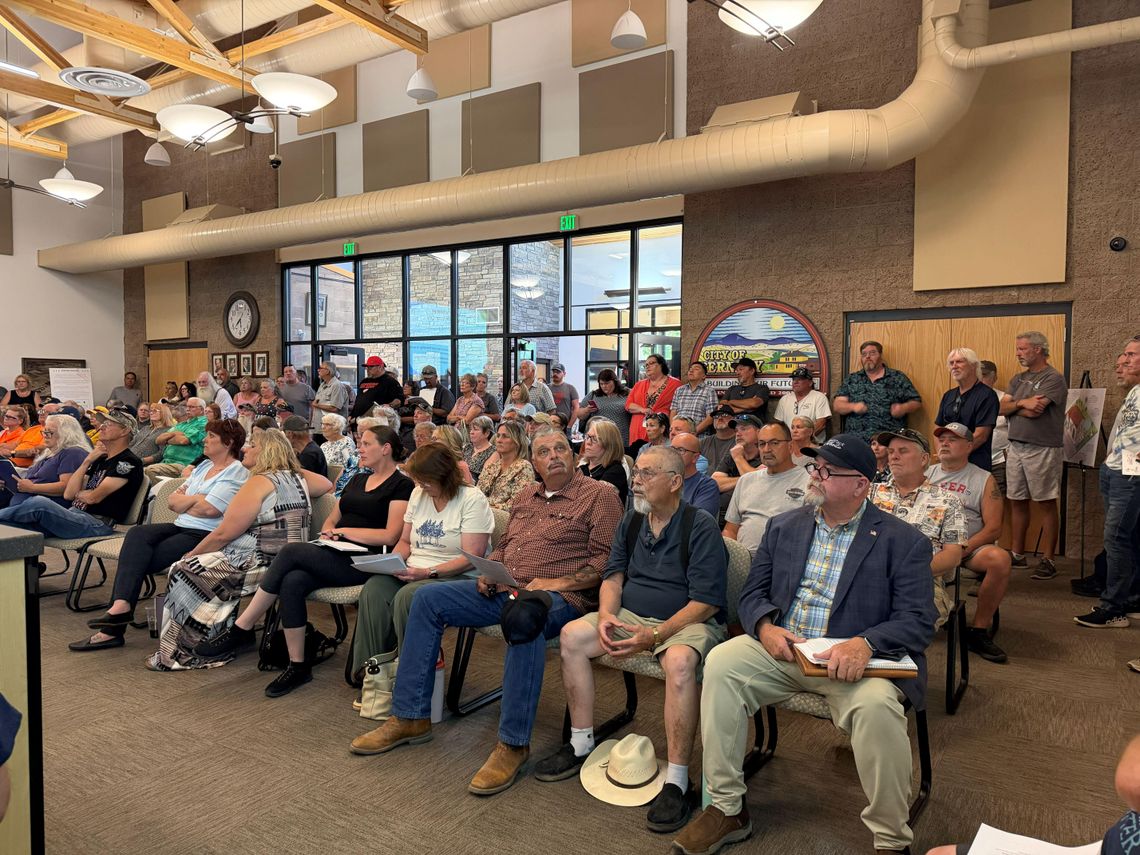
A standing-room-only crowd of nearly 200 residents filled the council chambers and lobby during a City Council code-enforcement workshop June 4, while an estimated 70 to 80 people attended an open-house-style discussion June 6 hosted by Mayor Neal McIntyre and Building Official Charity Birkel.
With public sentiment overwhelmingly opposed to the draft ordinance in its current form, residents asked McIntyre during the June 6 meeting to place an item on a future council agenda to set aside the proposal and begin developing a new plan.
“All I can do is present it to council and say the majority of the public, this is what they want,” McIntyre said. “I can do that. We’ll go back to the drawing board, and I will put on the agenda to bring the Title 16 forward, not for action, but for discussion and let everybody know where we’re at as far as this document goes.”
Under Fernley’s form of government, the mayor votes only to break a tie.
“What I do is meet with the councilpersons and try to convey to them what the public wants,” McIntyre said. “It’s up to the council that votes to make these changes.”
Near the conclusion of the June 4 workshop, a resident asked the council to make a motion to table the proposal.
City Attorney Aaron Mouritsen responded that the workshop agenda was for discussion only and that taking action would violate Nevada’s Open Meeting Law.
The June 4 workshop began with a presentation by Code Enforcement Officer Beth Engbrecht, who said the purpose was to provide information and gather public input on the draft ordinance.
Engbrecht explained that violations under the city’s current code are treated as criminal misdemeanors and can carry penalties of up to $1,000 in fines and six months in jail.
Under the proposed ordinance, enforcement would shift from criminal penalties to a civil process using administrative citations, civil penalties and cost recovery for city cleanup or abatement efforts when violations are not voluntarily corrected.
Engbrecht also said members of the code-enforcement department and Mouritsen visited Henderson on April 15 to review how that city addresses issues such as homeless encampments, stagnant water and other nuisance concerns.
Birkel said Henderson was selected because it was the first Nevada city to convert its code-enforcement system from criminal to civil enforcement.
She also said the intent was for the ordinance to be complaint-based, meaning investigations would begin only after the city receives a complaint from a resident.
During the June 4 workshop, 27 residents spoke in person and several others participated via Zoom.
Nearly all comments expressed opposition to the draft ordinance or specific provisions within it.
Some residents objected to individual sections of the proposal, while others argued the city should not regulate activities occurring on private property.
Others pointed to deteriorating roads, park maintenance concerns, limited city services and sewage issues as priorities they believe should be addressed before additional regulations are considered.
“You want to put restrictions on us, but yet you don't want to follow same restrictions and that needs to change,” resident Ken Sypher said. “If you're going to take care of Fernley, then take care of Fernley, fix Fernley first. If you're not, then get off our backs.”
During her comments, resident Nicole Guthrie asked how many people in attendance supported the proposal.
According to Guthrie, only two people raised their hands.
“You say you work for the people and you’re taking feedback,” she said. “There’s your feedback.”
Residents voiced similar concerns during the June 6 discussion.
Several said that if the ordinance remains complaint-based, property owners should be informed who filed the complaint against them, citing the Sixth Amendment right of an accused person to confront their accuser.
The prevailing sentiment at both meetings was that the city and neighboring residents should not interfere with how property owners use their own property.
“If you build a fence out of pallets because that’s all you can afford, let it be,” resident Don Maguin said. “It’s not hurting you. It helps that guy.”





Comment
Comments